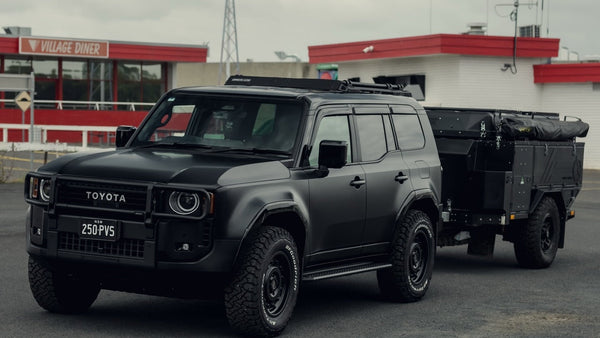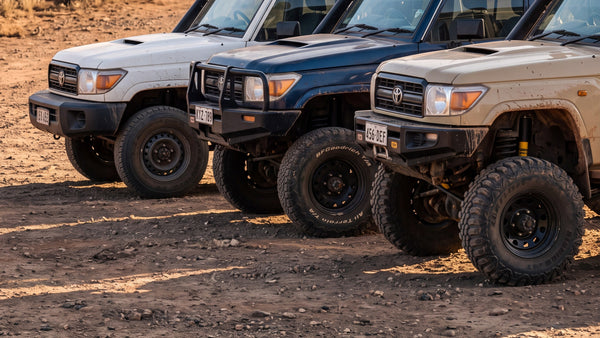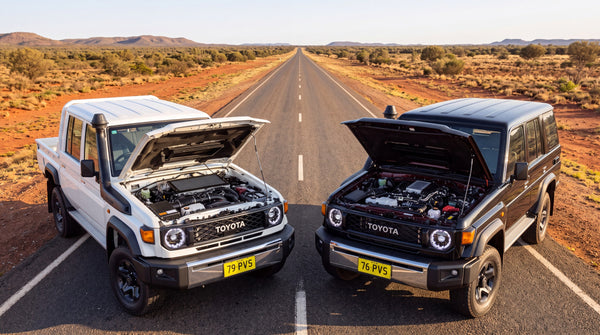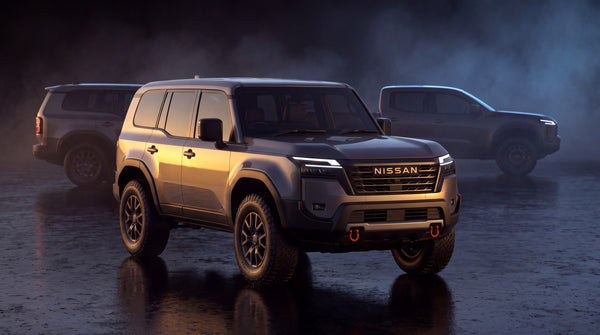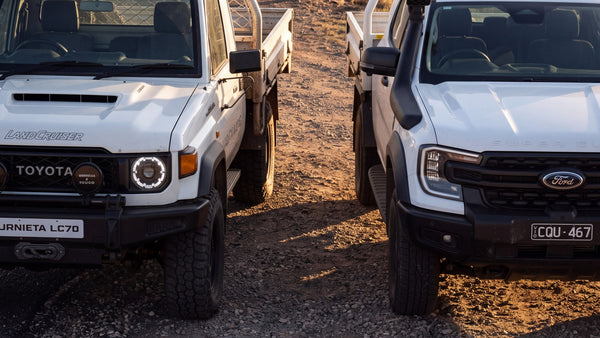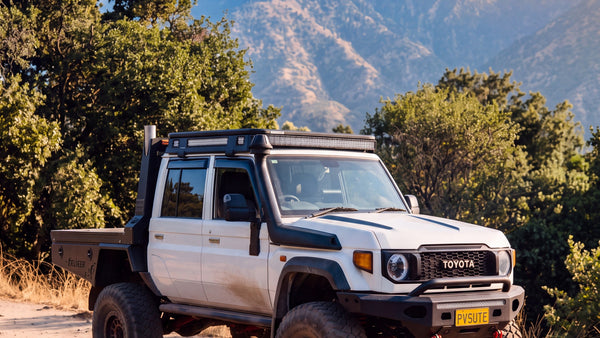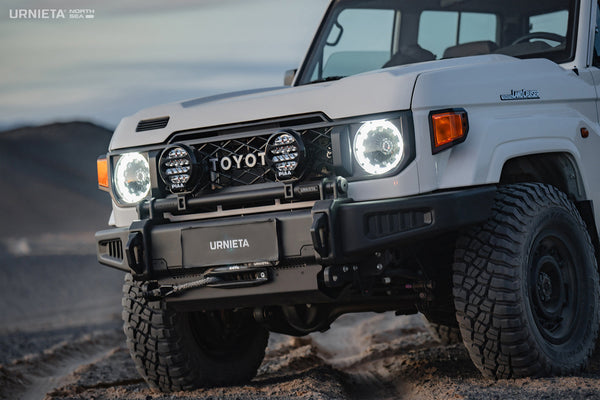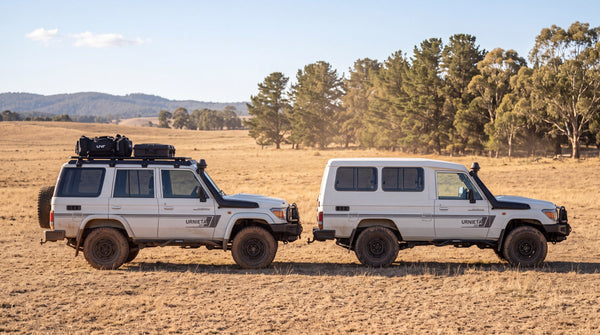



Four LandCruisers on the one mountain track, forty years between the first and the last, and each one is somebody's idea of the correct answer. The black 300 at the front is the modern tourer. The white 79 behind it is the modern work rig. The yellow 75 is old school. The sandy taupe 73 at the back is the beach cruiser. Put those four owners in a room and you won't get a consensus, you'll get an argument.
Worth having properly, because the argument isn't really about LandCruisers. It's about what you actually do on the weekend, how far from a dealership you break down, and whether you're buying a vehicle or buying back a decade.
At a Glance
- The 300 makes the towing and long-haul comfort case. The Performance Hybrid arrives mid-2026 from $156,060 with 341kW and 790Nm, the highest output ever in an Australian LandCruiser.
- The 79 makes the payload and repairability case. Relevant 70 Series variants sit at a 3,510 kg GVM, and accessories eat the difference faster than most owners expect.
- The 75 makes the simplicity case, and increasingly a money case. Overseas auction results for the FJ75 span roughly $18,000 to $116,000 across 13 documented sales.
- The 73 makes the fun case. Its auction record is tight, and 86 per cent of the ones offered found a buyer, which says more about supply than about demand.
- Every one of these vehicles is compromised. The useful question is which compromise you have to live with every single day rather than twice a year.
- The honest verdict depends less on the vehicles than on how many of them you can park.
The modern tourer: the 300 Series
The case is comfort under load, and it's a strong one. The Performance Hybrid confirmed for mid-2026 pairs a twin-turbo 3.4 litre V6 with an electric motor for 341kW and 790Nm combined, which is 114kW and 90Nm more than the 3.3 litre turbo diesel it sits above. Pricing starts at $156,060 for the GR Sport. Hitch three tonnes of caravan to that and drive to Broome, and the argument makes itself by the second hour.
What its owners leave out is the rest of the year. That capability is carried by a vehicle that's wide on a bush track, expensive to insure, and depreciating from a very high number while it sits in a suburban driveway five days a week. It's also the only one in the photo where a serious fault means a flatbed to a main dealer rather than an afternoon with a socket set.
Buy the 300 if you tow heavily and often, and do the school run in between. It's a poor answer if you tow twice a year and tell yourself it's more.
The modern work rig: the 79 Series
The case is that it's the only vehicle here still built to do a job rather than to represent one. You can buy it new, load it, tray it, and have it fixed in a town with one mechanic. Resale is the strongest of the four by a distance.
What its owners leave out is the payload arithmetic. Relevant 70 Series variants sit at a 3,510 kg GVM, and payload is that figure minus what the vehicle already weighs. A steel bull bar, a winch, a steel tray, drawers and full water can absorb several hundred kilograms before a passenger climbs in, which is why so many touring 79s end up needing an engineered GVM upgrade to stay legal. The cabin is the other omission. It's a genuinely noisy, sparse place to spend eight hours, and no amount of loyalty changes that.
Buy the 79 if your vehicle earns money, or if you tour far enough that repairability outranks comfort. If the tray never carries anything heavier than a fridge, that's a lot of compromise for an aesthetic.
Old school: the 75 Series
The case is that nothing on it can strand you in a way you can't solve. The 75 ran from 1984 until 1999, when it was split into the 78 Troopcarrier and the 79 ute and the front leaf springs gave way to coils. Across that run it carried the 2H four litre diesel, the 3F petrol six, the 1HZ 4.2 that's somehow still in production and the 1FZ-FE petrol six. No module decides whether you may start the engine.
It has also quietly become a money argument. The Classic Valuer's international record holds 13 documented FJ75 sales since 2020, running from about $18,000 to roughly $116,000, with a median near $45,000. Those are overseas auction results converted from pounds at around 1.91, so read them as a direction of travel rather than a valuation of the vehicle in your shed. Thirteen sales is a handful of transactions rather than a market, and an Australian buyer isn't bidding in the same room. Closer to home, a 1984 HJ47 with 546,936 kilometres made $9,500 at Australian auction in March this year, and a 1986 HJ60 showing 596,928 kilometres made $22,000. Neither is a 70 Series, they're the 40 and 60 either side of it, but both had passed half a million kilometres and both still found real money.
What its owners leave out is what those hours feel like. Drum-slow, loud, unassisted by any safety system worth the name, and rusting from inside the chassis rails while it sits. The good ones are expensive precisely because most of them aren't good.
The beach cruiser: the 73
The case is the one nobody can argue with on paper, so they argue with it anyway: it's the most fun. Mid wheelbase, three doors, roof off, nothing to damage, and a breakover angle the other three can't approach. It's the spiritual ancestor of the short wheelbase 70 Series Toyota still builds for the Middle East and South America and isn't sold here today.
The market has noticed. The FJ73's auction record is only six sales, but they sit in a remarkably narrow band, equivalent to roughly $29,000 to $31,000, and 86 per cent of the ones offered sold. A tight spread with almost everything clearing is the signature of a small pool of surviving examples rather than a crowd of buyers.
What its owners leave out is that it carries nothing, tows little, drinks fuel through a carburettor on the petrol cars, and is an unpleasant place to be on a highway at 110. It's a second vehicle wearing the costume of a first one.
The arguments that don't survive contact
Three claims come up in every version of this debate and none of them hold.
The first is that the old ones are more reliable. They're more repairable, which is a different property. A 1988 75 with 400,000 kilometres will strand you more often than a new 79, and you'll be able to fix it yourself when it does.
The second is that the new ones aren't real LandCruisers. The 79 you can buy today is assembled to do the same job the 75 did, and does it with more payload and better brakes. Nostalgia isn't a specification.
The third is that the classics are a guaranteed investment. Six sales and thirteen sales are not a trend line. A dry, original, documented example has climbed. A rusty one hasn't, and no market commentary changes what a buyer thinks once they get underneath it.
The verdict
The debate only looks unresolvable because it's usually run as though you own one vehicle. Answered that way it isn't close: the 79 wins. It's the only one of the four that can work, tour and still be worth money in ten years, and its weaknesses are the ones you can spend your way out of. The 300 takes it only if you genuinely tow heavy loads long distances, in which case nothing else here is a serious contender.
Answered honestly, though, most people arguing about this own two vehicles or would like to. That changes the answer completely. The two-vehicle garage that works is a 79 or a 300 doing the actual work, and a 73 that costs nothing to insure, doesn't care about a scratch, and is worth more the year after you buy it. The one combination that never works is the single old vehicle asked to be everything, because the compromise you thought you were making twice a year turns out to be the one you make every morning.
If you own the old one
The changes worth making to a 73 or a 75 are the ones you can undo. The steering wheel is the honest first move, because the original is a wide, thin rimmed thing designed around a steering box with plenty of play, and it's the one component your hands are on for every minute of every drive. Our 70 Series steering wheel upgrade kit covers these, though a steel dash 70 Series needs the boss kit adaptor first, because there's no factory airbag hub for a modern wheel to bolt to. That adaptor covers 1984 to 2008, which is exactly this era.
Keep whatever you remove, label it, and put it in a box in the corner of the shed. Bolt-in beats cut-in every time, and the next owner will pay for that box.