


The LandCruiser 70 Series went on sale in 1985 and you can still order one new in 2026. No other vehicle on the Australian market comes close to that run. The usual explanation credits the buyers: miners, graziers, tourers, people who want a live axle and a ladder frame and won't be talked into a Prado. That explanation misses half the story.
The other half is written in the Australian Design Rules. Three times in the past decade the ADRs have put the 70 Series in a position where it had to change or leave the market. Each time, the change that followed was ordered by a rulebook, not asked for by an owner.
At a Glance
- In 2016 the single cab was re-engineered to a five-star ANCAP rating with five airbags and a strengthened chassis. The dual cab, the variant families buy, missed out.
- In September 2022 Toyota lifted every 70 Series GVM to 3,510kg, 10kg past the 3,500kg line, moving the range out of reach of the incoming pole side impact rule.
- The late 2023 update added autonomous emergency braking ahead of ADR 98/00's March 2025 deadline, the same rule that took the three-door Jimny off sale for almost a year.
- The rulebook follows you too: lift height, tyre size, bar work and the steering wheel each carry their own compliance load, and the answers change at state borders.
The 2016 rescue, for one body style
The first episode is the one the system can point to with some pride. When stability control became unavoidable, Toyota fitted VSC, active traction control and hill start control across the 70 Series range. The single cab got much more: five airbags including curtain and driver's knee, thicker chassis rails, modified crossmembers and around a dozen new or thicker body panels. That work earned the single cab a five-star ANCAP rating in 2016, on a body designed when Bob Hawke was Prime Minister.
Look at what the same episode did to the rest of the range. The dual cab, the variant most likely to have a family in it, kept the lesser airbag count. For years Australia's favourite crew vehicle for remote work carried less protection than the single cab parked next to it in the same dealership. No buyer chose that. The rulebook produced it, by making one body style worth the engineering spend and leaving the others where they were.
Ten kilograms of paper
The second episode should embarrass everybody involved. From 1 November 2022, ADR 85 required new light commercial vehicles to pass a pole side impact test that a body engineered in the 1980s was never going to pass. Toyota's answer, in September 2022, was to raise the GVM of every 70 Series variant to 3,510kg. That's 10kg past the 3,500kg line separating light vehicles from heavier classes, so the whole range was reclassified as a medium goods vehicle and the rule stopped applying.
Nothing about the side structure changed. The GVM rise ran from 110kg on the single cab to 450kg on the wagon, and payload rose with it, so owners did collect something real. But sit with what happened. A safety standard written to protect people in side impacts was stepped over with a reclassification, lodged and approved through the proper channels. A rule you can exit with ten paper kilograms was never really protecting occupants. It was defining a category, and the category moved.
The braking rule that culled the field
The third episode looked like the one that would finally end the 70 Series. ADR 98/00 made autonomous emergency braking mandatory on newly introduced models from March 2023 and on every new vehicle sold from March 2025, with a system that has to detect another vehicle and brake between 10 and 60km/h. A four-decade-old platform with a mechanical soul was exactly what this rule was expected to retire.
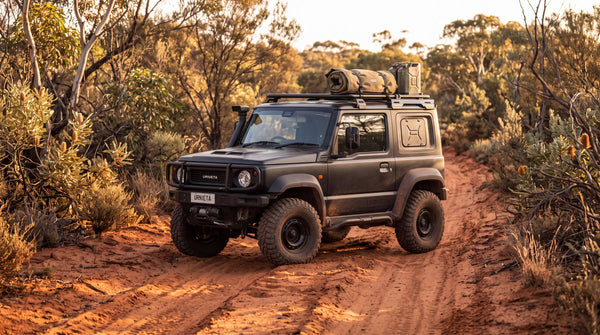
Instead, the late 2023 update brought AEB and the wider driver aid package to the 70 Series, and the deadline passed without drama. Other nameplates weren't so lucky. The three-door Suzuki Jimny came off sale in March 2025 because its braking system didn't meet the rule, and only returned in February 2026 once a compliant one was fitted. A year of a popular, affordable 4WD missing from the market is a strange way for a safety rule to deliver safety.
That's the honest lesson of ADR 98/00. It didn't make vehicles safe, it removed vehicles until their makers paid the bill. The 70 Series cleared a 2025 rule because Toyota judged Australia worth the engineering spend, and a 1985 design outlived newer, cheaper, better-protected models whose makers judged otherwise. Under the ADRs, survival is a budget decision made in a head office, not a merit decision made on a test track.
You inherit the rulebook
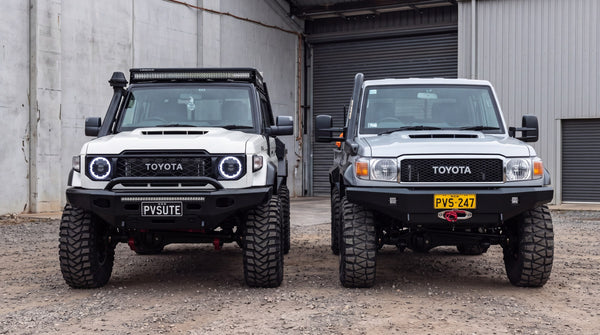
Registration doesn't end the paperwork, it hands it to you. The moment your 70 Series leaves the dealership and starts becoming the vehicle you actually need, the same regulatory instinct follows it home. Suspension lift, tyre diameter, bar work, seating, GVM upgrades and the steering wheel each sit under their own mix of design rules, national codes of practice and state regulation. The permitted answer can change when you cross a border. You can legally run a setup in one state that would attract a defect notice in the next.
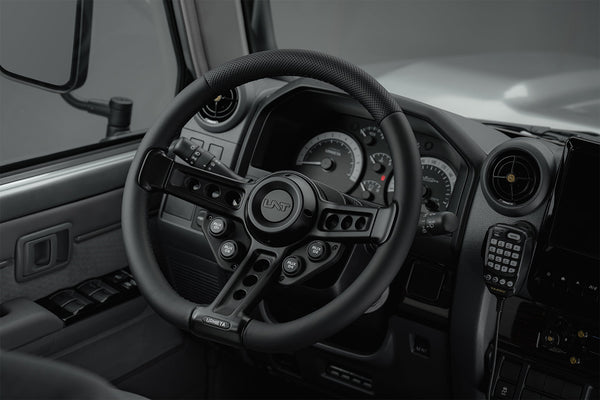
The steering wheel is the sharpest example on a 70 Series, because what matters legally is what the part does, not what the catalogue calls it. We've covered the detail in our guide to aftermarket steering wheels and the ADRs. The short version: the rules are navigable when the engineering is done properly, and that's the standard the compliant end of the aftermarket holds itself to. The load of proving it falls on you and your supplier, not on the system that wrote rules no two states read the same way.
Who decides what Australians drive
The next decade of the 70 Series is already drafted, and again it's drafted in Canberra rather than Toyota City. Emissions penalties arrive from 2027, covered separately in our piece on the NVES and the 70 Series, and more driver aid mandates will follow as Australia adopts each new international regulation. Each one will arrive the way the last three did: as a bill Toyota pays, a workaround the regulator accepts, or a body style that quietly disappears from the price list.
The 70 Series has outlived every rule written in its lifetime, but every survival was decided in a meeting no buyer attended. A design law that can be stepped over with ten paper kilograms, that armoured the single cab while the dual cab carried the family, and that parked a rival 4WD for a year while paperwork caught up, isn't obviously protecting anyone. It's deciding what you get to drive. A system with that much power over the market deserves at least as much scrutiny as the vehicles it sits in judgement of.