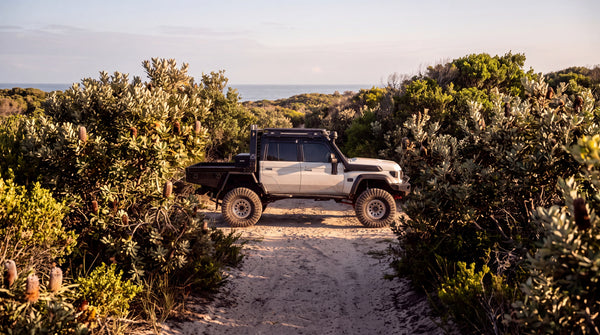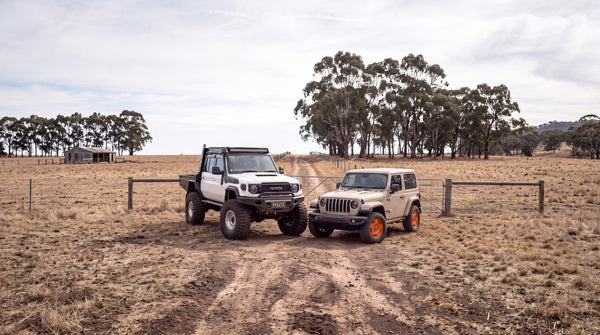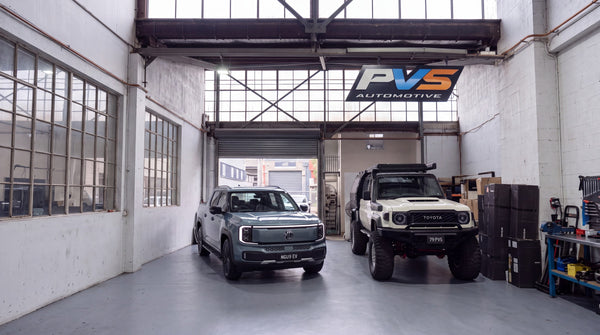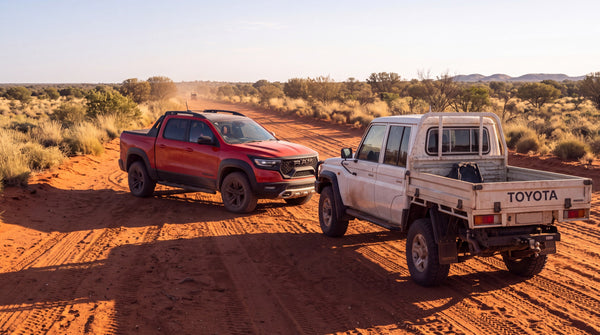



Australia's four-wheel drive market has changed shape faster in the past two years than it did in the previous ten. You can walk into a dealership today and order one of eight plug-in hybrid four-wheel drives, with another five confirmed or strongly signalled before the end of 2027. They're a mix of dual cab utes and large wagons, towing ratings run from 2,500kg to 3,500kg, and several make more power than anything Toyota has ever put in a 70 Series.
That wave arrived in the same 12 months the other end of the market moved the opposite way. The 4.5-litre V8 turbo-diesel 70 Series is finished, the range carries on with the 2.8-litre four-cylinder only, and from MY26 every 70 Series sold here arrives with a 20-litre AdBlue tank to meet Euro VI emissions rules under ADR 80/04. Two very different answers to the same regulatory pressure, at the same time.
At a Glance
- Eight plug-in hybrid 4x4s are on sale in Australia now, led by the BYD Shark 6, Ford Ranger PHEV and GWM Cannon Alpha PHEV.
- Claimed EV-only range runs from about 49km (Ranger PHEV) to about 120km (GWM Tank 500 Hi4-T), on different and not directly comparable test cycles.
- Five more are coming, including the JAC Hunter PHEV from August 2026 at a claimed 360kW and 1,010Nm.
- The V8 70 Series is out of production, and MY26 four-cylinder models run a 20-litre AdBlue tank for ADR 80/04.
- Toyota hasn't announced a plug-in hybrid 70 Series for Australia, so the two paths stay separate for now.
The plug-in 4x4s you can buy right now
BYD Shark 6. The vehicle that started the conversation. A 1.5-litre turbo petrol engine paired with an electric motor on each axle for a combined 321kW and 650Nm, a 29.58kWh battery, a claimed 100km of EV-only running and 2,500kg braked towing.
Ford Ranger PHEV. The opposite philosophy. Ford kept the 2.3-litre turbo petrol four and added a single electric motor for 207kW and 697Nm, with a much smaller 11.8kWh battery good for about 49km. In exchange you keep the 3,500kg braked towing capacity of the diesel Ranger and the chassis hardware that goes with it.
GWM Cannon Alpha PHEV. 300kW and 750Nm, more than 100km of claimed EV range, 3,500kg braked. GWM has been the most aggressive of the newcomers on both price and specification.
GWM Tank 300 Hi4-T and Tank 500 Hi4-T. Wagons rather than utes, both with the same 300kW and 750Nm system and a 37.1kWh battery, claiming roughly 115km and 120km of EV range respectively on the NEDC cycle. Braked towing is 3,000kg.
Land Rover Defender 110 P400e. The one that's been here longest and rarely gets counted. 297kW and 640Nm, a 19.2kWh battery, about 50km of EV range and 3,000kg braked.
Denza B5 and B8. BYD's upmarket badge, and the numbers are serious: 400kW and 760Nm for the B5, 425kW and 760Nm for the B8, with 31.8kWh and 36.8kWh batteries and roughly 90km and more than 100km of claimed EV range. The B5 was announced at around $74,990 before on-road costs.
What's coming next
JAC Hunter PHEV, from August 2026. A claimed 360kW and 1,010Nm, about 100km of EV range and 3,500kg braked, announced from $49,988 plus on-road costs for the Pro and $54,844 for the X. That's a lot of stated output for the money.
Chery Stockman, Q4 2026. 350kW and 800Nm, about 100km of claimed EV range on NEDC, 3,500kg braked. Pricing isn't confirmed.
Nissan Frontier Pro PHEV, 2026 to 2027. Around 320kW and 800Nm from a 33kWh battery, with a claimed 135km of EV range on the CLTC cycle and 3,500kg braked.
GWM Cannon Hi4-T, late 2026. The smaller Cannon gets the 300kW and 750Nm Hi4-T system and 3,500kg braked towing.
BYD Yangwang U8, late 2026 or beyond. The outlier. Roughly 880kW and 1,280Nm from four motors, a 49kWh battery and about 180km of claimed EV range. Treat the timing as loose.
One caveat worth holding onto: those EV range figures come from NEDC, WLTP, WLTC and CLTC cycles depending on the brand. None of them are measured towing a van up a hill on corrugations. Real-world touring numbers for this class of vehicle are still being written.

The 70 Series has outlived several waves of predicted replacements. This one arrives with better numbers than most.
Meanwhile, the V8 left the building
Toyota ceased production of the 4.5-litre V8 turbo-diesel and final V8 deliveries have worked their way through dealer stock. The 70 Series now runs the 2.8-litre four-cylinder turbo-diesel alone, making 150kW between 3,000 and 3,400rpm and 500Nm between 1,600 and 2,800rpm on automatic variants. Whether that makes the last V8 79 Series a collectible is a longer argument, and we've made the case for and against it in our piece on V8 LandCruiser values after discontinuation.
The regulatory reason those two stories share a calendar is the same in both cases. ADR 80/04 brought Euro VI emissions standards to all applicable new vehicles sold in Australia from 1 November 2025. Manufacturers had a choice about how to meet it. The plug-in brands added batteries. Toyota added selective catalytic reduction, which is what the 20-litre AdBlue tank on every MY26 70 Series is for. If AdBlue is new to you, our AdBlue guide for 70 Series owners covers tank size, refill intervals and what happens if you run it dry.
Worth knowing if you're buying a Troopcarrier: fitting the AdBlue hardware cost the 78 Series fuel capacity, which drops from 180 litres to 130 litres. That's a real touring consideration, and the sort of trade-off that doesn't show up in a power figure.
What this actually means for a 70 Series owner
Not much, immediately, and that's the point. A plug-in ute with 300kW and 100km of electric range solves a commuting problem and a job-site power problem. It doesn't yet solve the problem the 70 Series was built for, which is going a very long way from a power point with a load on the back and a parts supply any workshop in the country can service. Payload, chassis simplicity, aftermarket depth and resale are still the 70 Series case, and none of them changed this year.
What has changed is the comparison your next buyer will make. If you're holding a V8 79 Series, supply is now fixed and the successor is genuinely different in character, which is the classic setup for firm used values. If you're ordering an MY26, you're buying into a fuel and fluid routine with one more line in it, and a Troopy with a smaller tank than the one your mate bought two years ago.
The other quiet shift is inside the cabin. Every vehicle listed above ships with a large screen, wireless phone mirroring, steering wheel controls that talk to it and USB-C charging that keeps up with a modern phone. That's the gap a late 2009 to 2026 70 Series interior shows most obviously against a showroom full of plug-ins, and it's the one part of the comparison you can close without changing vehicles. A 9-inch MK4 head unit and a steering wheel upgrade kit with wireless controls put the same functionality behind the same dash.
Thirteen plug-in four-wheel drives in a market that had one is a genuine change, and worth watching rather than dismissing. It just isn't the end of the diesel 70 Series, which has quietly outlasted every wave of replacement predicted for it since the early 2000s.