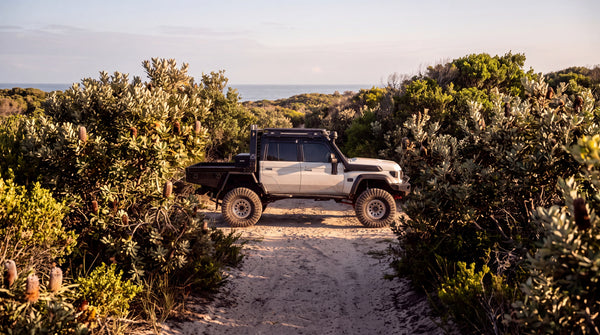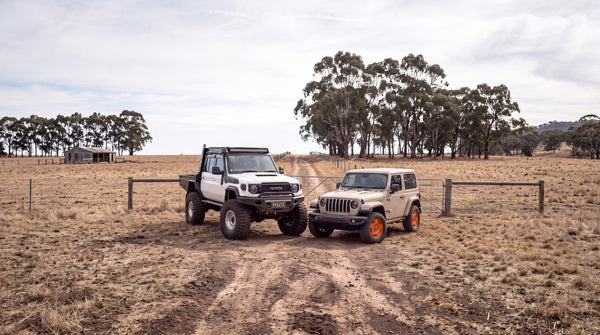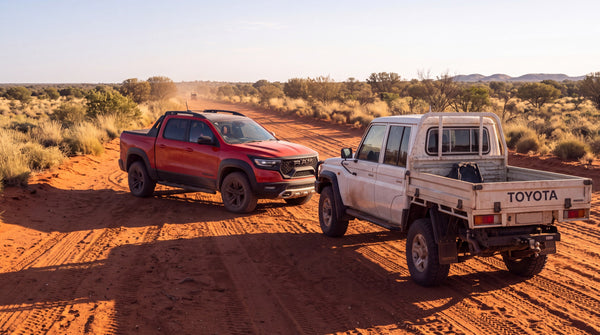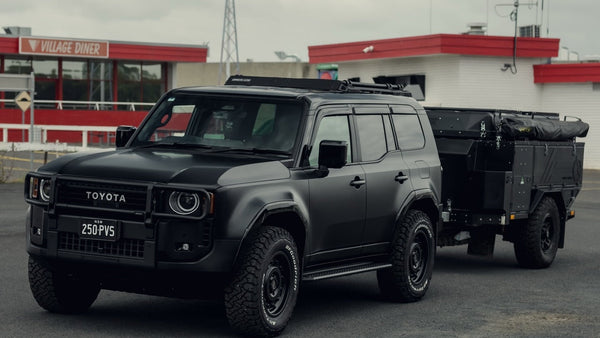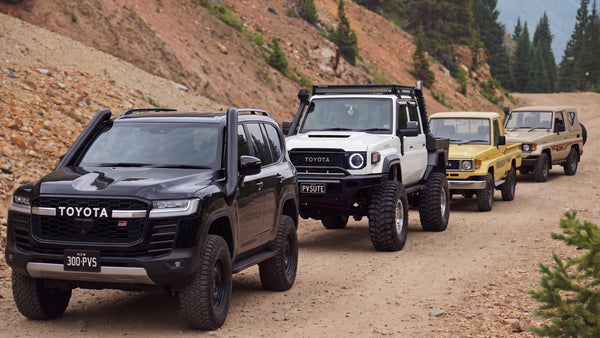



The Toyota LandCruiser 70 Series has been doing serious work across Australian farms, mine sites and outback tracks since 1984, and it's still in production today. Line up a 2008 WorkMate against a 2023 GXL and you're looking at two very different safety propositions. Where your build year sits on that spectrum isn't trivia: it changes how you modify your vehicle and how you plan for the unexpected.
Toyota Australia re-engineered the 70 Series in waves rather than with a full model change. That means the safety equipment story is tied closely to specific model years.
At a Glance
- 2009: dual front airbags and an extended front bumper became standard across the range
- 2012: ABS rolled out across all 70 Series variants
- 2016: major re-engineering delivered a five-star ANCAP rating on the single cab-chassis, with curtain airbags, electronic stability control, and cruise control
- 2022: autonomous emergency braking (AEB) added alongside payload increases
- 2023: facelift introduced further driver aids
If your 70 was built before 2009
Your vehicle left the factory without front airbags as standard equipment. That's not a criticism: these vehicles were engineered to a different era's standards, and they've proven themselves extraordinarily durable. It's still a fact worth knowing.
The 2009 update mattered because dual front airbags became standard fitment. Toyota also extended the front bumper structure to improve frontal impact geometry. If you're shopping used, 2009 is a meaningful dividing line.
2012: ABS across the range
Anti-lock braking wasn't a given on the 70 Series until 2012. From that model year on, ABS became standard across all variants.
On loose gravel, corrugated dirt or a wet highway, ABS can meaningfully reduce stopping distances and keep steering control in your hands under heavy braking. If your vehicle predates 2012, factor that into how you drive and how you plan your load management.
2016: the big re-engineering and five stars
The 2016 update was the most substantial safety re-engineering the 70 Series had seen in its modern life. Toyota brought the single cab-chassis to a five-star ANCAP rating, which required curtain airbags, electronic stability control (ESC) and cruise control.
For a platform positioned as pure utility, five stars was a significant engineering achievement. It also said plenty about where the commercial and fleet market was heading. Buyers spec-ing new vehicles for mine-site or government work increasingly required ANCAP ratings, and Toyota responded.
2022: autonomous emergency braking and more payload
The 2022 model year brought autonomous emergency braking to the 70 Series. The technology had gone mainstream across the passenger car fleet but was slower to arrive on heavy-duty utilities.
AEB uses sensors to detect an imminent collision and apply the brakes if you don't respond in time. The 2022 update also included payload increases, which mattered enormously to commercial and agricultural operators pushing up against the limits of the previous ratings.
2023 facelift: the driver aids mature
The 2023 facelift continued the trajectory, adding further driver aids to the range. The 70 Series is now a genuinely well-equipped vehicle by modern standards, a long way from its origins as a bare-bones tool of trade.
If you're modifying an older 70
On pre-2016 or pre-2009 vehicles, think the safety equipment gap through before you start. The principle is simple: if your vehicle does have airbags, any modification that touches the steering column or steering wheel has to preserve that airbag system's integrity.
Fitting an aftermarket steering wheel that bypasses or disables the airbag circuitry removes a piece of safety equipment that was engineered into your vehicle.
That's why ADR-compliant steering wheel and control solutions matter. PVS Automotive wireless steering wheel control kits are designed to work with your vehicle's existing airbag system, not around it, so you can add aftermarket functionality without compromising the safety architecture you already have. It's a small detail that becomes a very large one in a frontal collision.
Check your build year
If you're unsure what safety equipment your 70 Series was built with, the compliance plate and the Toyota Australia build records are the reliable reference. Your local Toyota dealer can confirm what was standard for your specific VIN.
Do that before you modify anything, and before you make assumptions about what your vehicle will and won't do in an emergency.
Toyota has kept the 70 Series relevant by layering in modern safety technology without losing the character that made it famous. On a 2008 workhorse or a 2023 GXL, knowing where your vehicle sits in that timeline is the starting point for every sensible modification decision you make.