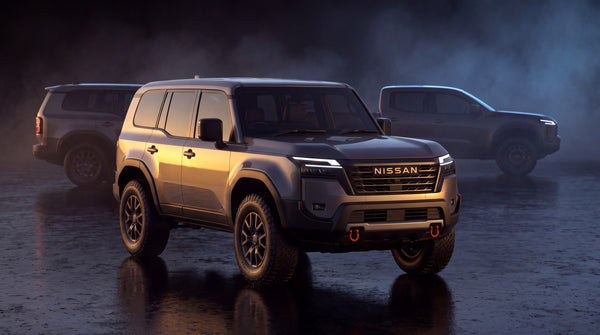



Jaguar Land Rover recently brought the Defender OCTA to Australia for a controlled drive day at a driver training facility south of Brisbane, and the facts alone are worth sitting with for a moment. The OCTA starts above A$305,200. It rides on 33-inch all-terrain tyres from the factory. It has a wider track than a standard Defender, greater ground clearance, quad exhaust outlets, a dedicated off-road drive mode called OCTA Mode, and a BMW-sourced 4.4-litre mild-hybrid twin-turbo petrol V8. It also has launch control, which you get exactly 100 uses of across the vehicle's lifetime. After that, it's gone. That's not a quirk, that's a design choice on an A$305,000-plus vehicle, and it tells you something important about what the OCTA actually is.
The OCTA is a performance statement dressed as a 4x4. It's spectacular engineering aimed at buyers who want maximum drama and the badge to match. None of that is a criticism. But if you run a 79 Series up and down the Cape every year, or you're spec'ing a dual cab for a mining site in WA, the OCTA's story is less a threat and more a mirror. It shows exactly what the LandCruiser 70 Series is not, and why that's a strength.
At a Glance
- The Defender OCTA is priced from over A$305,200 in Australia and runs a BMW-sourced 4.4-litre mild-hybrid twin-turbo V8.
- It comes on 33-inch all-terrain tyres from the factory, with a wider track and more ground clearance than the standard Defender.
- Launch control is fitted but limited to 100 activations across the vehicle's life.
- The 70 Series 2.8-litre four-cylinder diesel starts at a fraction of that price and carries 30-plus years of aftermarket support behind it.
- What you can do to a 70 Series, in terms of lifts, GVM upgrades, long-range tanks and tray work, is a fundamentally different conversation.
What the OCTA actually gets right
The 6D Dynamic suspension system is the headline piece of the OCTA's engineering. It's designed to absorb high-speed off-road impacts in a way that standard adaptive dampers can't, and the dedicated OCTA Mode adjusts ABS and stability control tuning to match. On a wet skid pan, with the rear stepping out through hairpins and the car remaining composed, that system does what it promises. The torque is immediate and massive. The on-road refinement is in a different league from any working 4x4. If your use case involves long motorway runs between two capital cities with occasional off-road detours, the OCTA is genuinely capable and genuinely fast.
It's also honest about what it is. Land Rover isn't marketing this as a GVM-upgraded, canopy-fitted, long-range-tanked expedition rig. They're selling a halo product to a specific kind of buyer, and the OCTA delivers for that buyer. That deserves to be said plainly.
Where the 70 Series argument starts
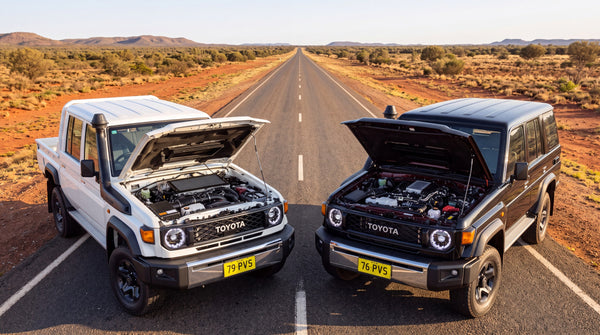
The LandCruiser 70 Series costs a fraction of the OCTA's asking price, and it arrives with a drivetrain, a chassis and a parts ecosystem that Australians have been building on since the 1980s. The current 2.8-litre GD-T four-cylinder with AdBlue isn't the V8 that everyone misses, but it's serviceable in places where you can't carry a BMW-spec diagnostic tool. That matters.
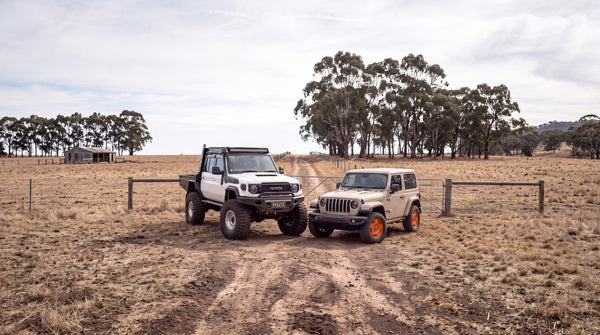
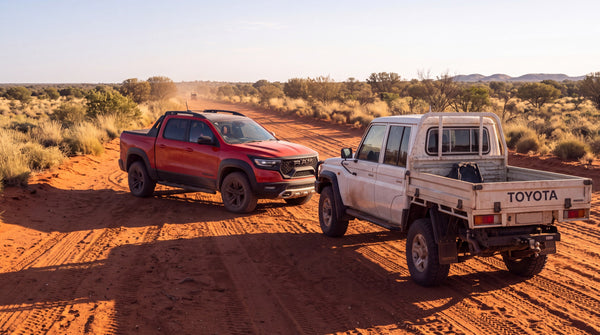
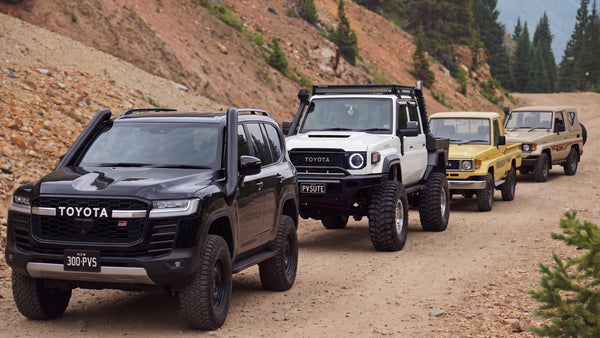
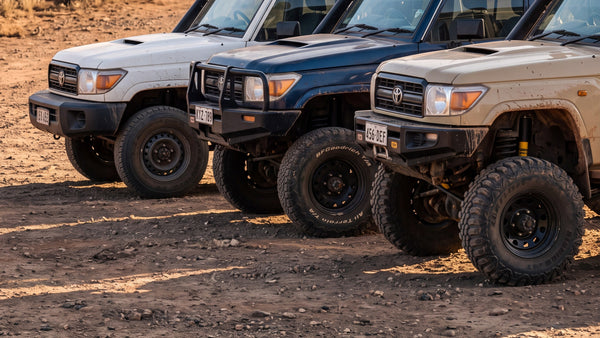
What you can do to a 70 Series is a long list. A 4-inch lift on 35s with a GVM upgrade is a documented, compliance-stamped process with multiple suppliers across the country. Long-range auxiliary tanks, dual battery systems with DC-DC chargers, full tray and canopy setups, snorkels, rear drawers, winch mounts and bull bars built to Australian standards. Every one of those modifications has been done tens of thousands of times on these platforms. The parts exist at every major centre and most smaller ones. The knowledge exists on forums, in workshops and in the heads of people who've been fitting 70 Series accessories since before some current buyers were born.
A 33-inch tyre is actually where the stock OCTA sits. The 70 Series community treats 35s as a starting point and 37s as a serious conversation. The platforms are not even playing the same game.
The modification question no one asks the Defender
The Defender has an aftermarket. It has lift kits, accessory bars and some tray solutions, and that's worth saying clearly. But 30-plus years of Australian-specific fitment knowledge, GVM upgrade programmes, and the kind of parts availability that means you can source a wheel bearing in Longreach on a Tuesday is a different depth of support entirely. You're not building an OCTA into a mine-spec work rig or a Cape York tourer. That's not what it's for, and pretending otherwise wouldn't be fair to either vehicle.
The honest gap isn't capability on a manicured off-road course. The gap is what happens after 80,000 kilometres of hard use, 200 kilometres from the nearest town, in a vehicle that cost you A$305,000 and runs a proprietary mild-hybrid V8 from a different manufacturer. The 70 Series crowd have an answer for that scenario. It's the same answer they've had for decades.
So which one wins?
The OCTA wins if you want the most technologically advanced, fastest, most composed luxury off-roader that money can buy in Australia right now. That's a real win and it belongs to Land Rover. But the 70 Series wins if the question is which platform you'd actually trust across the Gibb River Road, loaded, solo, in the wet, with no recovery crew behind you. Those are two different questions, and the fact that the OCTA's existence makes us ask them more clearly is, genuinely, the most useful thing the OCTA has done for 70 Series owners.
The 70 Series isn't perfect. The V8 is gone, the 2.8 divides opinion, and the interior hasn't kept pace with the price. But the argument for it, the real one, is the 30-year aftermarket, the GVM programmes, the parts on the shelf and the platform you can rebuild anywhere in the country. That argument doesn't get weaker because Land Rover built something with launch control and a 100-use limit. It gets stronger.