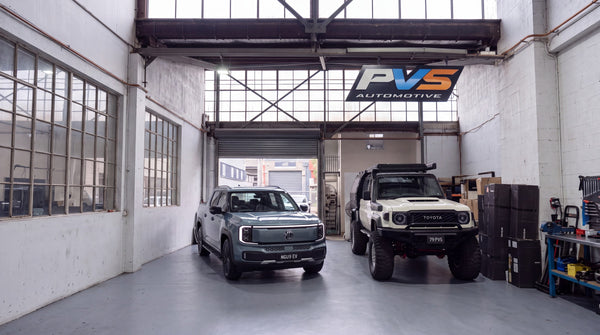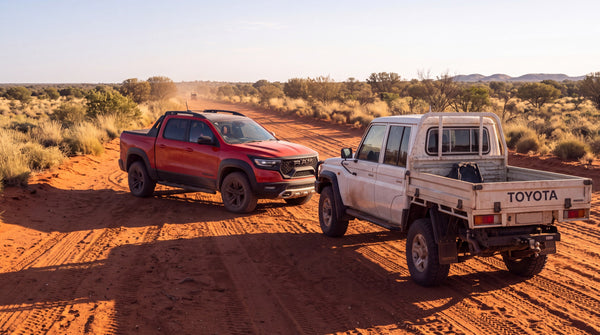



GWM's Tank 300 PHEV is now in Australia and it's priced aggressively. The top-spec Ultra Hi4-T sits at $61,990 drive-away, with the entry Lux PHEV variant starting at $57,990. A 2.0-litre turbocharged petrol engine pairs with a 37.1kWh battery to produce a combined 300kW and 750Nm of system torque. For context, a current 79 Series single cab with the 2.8-litre four-cylinder makes 150kW and 500Nm from the factory. The Tank 300 PHEV makes half again as much torque, and it'll run on 91RON standard unleaded when the petrol engine cuts in.
The claimed fuel economy on a charged battery sits at 1.9L/100km NEDC, rising to 8.3L/100km when the battery is depleted. GWM claims a combined driving range of up to 955km, and a 115km electric-only range under NEDC conditions. A 50kW DC fast charge takes the battery from 30 to 80 per cent in a claimed 24 minutes. The kerb weight is 2615kg, GVM is 3225kg, payload is 610kg and the braked tow rating is 3000kg. Those are working numbers, not just weekend numbers.
At a Glance
- GWM Tank 300 Ultra Hi4-T priced at $61,990 drive-away in Australia
- 300kW / 750Nm combined system output from a 2.0L turbo-petrol and 37.1kWh battery
- 115km electric range (NEDC), 3000kg braked tow, 610kg payload
- Interior infotainment is the older GWM system, not the updated Coffee OS from the Tank 500 or Cannon Alpha
- A new 79 Series single cab costs well over $70k before on-roads; a new 76 wagon more again
What it does well
Give this vehicle its credit. A PHEV drivetrain means near-silent running on short commutes and job-site work, with the electric motor delivering instant torque from a standstill. If your 70 Series spends three days a week idling in traffic between worksite visits, that running cost comparison starts to sting. The Tank 300 also comes with a rear locking differential as standard, front locker on the Ultra, all-terrain mode selection and a full-size spare. It's part-time four-wheel drive, not a softroader with AWD marketing copy.
The spec sheet is genuinely long for the price. Nappa leather seats, heated and ventilated fronts, a 12.3-inch digital cluster, 12.3-inch touchscreen, wireless Apple CarPlay and Android Auto, a 220V power outlet in the boot and a 9-speaker premium audio system all come on the Ultra PHEV. A tow drive mode is included on PHEV variants. At $61,990 drive-away, that's a lot of equipment against a 79 Series whose factory 6.7-inch screen runs wired CarPlay and Android Auto and not much else in the way of comfort tech.
Where the 70 Series holds the ground
The Tank 300 PHEV weighs 2615kg. That's a heavy number for a compact off-road SUV, and it's weight sitting high up in a 37.1kWh battery pack. When you're picking a line on a sidehill or bridging a rut, mass and centre of gravity matter more than claimed outputs. The 70 Series is a lighter, simpler structure and that's not an accident.
Then there's what you can actually do to the platform once you own it. A 70 Series can take an engineer-certified 4-inch lift on 35s with a well-documented parts list and a local 4WD shop that's fitted that combination hundreds of times. GVM upgrades through IMEX, Pedders or a state-certified engineer are a known path, adding meaningful payload for touring or tray work. Long-range fuel tanks from Brown Davis or Titan drop straight in. Dual-battery and DC-DC charging systems are a weekend job. A flat-tray or custom canopy bolts to a chassis that's been the same basic architecture since the 1980s. The Tank 300 PHEV has been on sale here since March 2026. That aftermarket ecosystem does not exist yet, and for a vehicle carrying a large battery pack and a 9-speed hybrid transmission, the engineering complexity around a lift or a GVM upgrade is a different conversation entirely.
Parts availability matters too. If your 79 breaks down in Birdsville, there's a chance someone nearby has a donor vehicle or a workshop that recognises the engine. That's thirty-plus years of penetration into the Australian outback. The Tank 300 PHEV is not in that category yet, and it may never be. That's not a knock, it's just where things stand in 2026.
The honest scorecard
The Tank 300 PHEV wins on price, on day-to-day running costs, on power output and on urban comfort. If your off-road work is weekends on graded tracks and your week is Sydney or Brisbane traffic, the numbers make sense. There have also been early reports of throttle response issues and ride quality concerns from pre-production driving, so a long-term real-world test will be important before drawing final conclusions on reliability and dynamics.
The 70 Series wins on repairability, on modification depth, on outback parts access and on a known engineering baseline that's been stress-tested on Australian roads for decades. The V8 is gone, and the 2.8 with AdBlue is the only new option now. That's a real concession. But the platform around that engine, the chassis, the axles, the transfer case, the thirty-year aftermarket, is still the benchmark for anyone who genuinely needs their vehicle to work a long way from a dealer network.
Here's the position: if you're buying a LandCruiser 70 in 2026 purely for weekend touring on maintained tracks and you're price-sensitive, the Tank 300 PHEV is the first Chinese off-roader that deserves a test drive before you sign. If you're building a serious touring or work rig that needs to be fixable, liftable and loadable anywhere in the country, the 70 Series is still the answer. Those are two different buyers, and both of them are right.
The argument worth having in the comments is this: at what point does the GWM aftermarket grow deep enough to close that gap? Because it's not there yet, and the 70 Series community knows it.