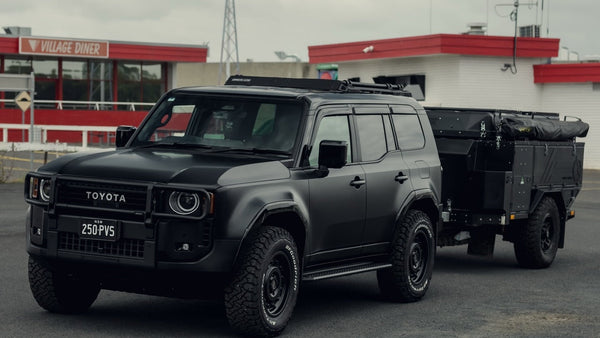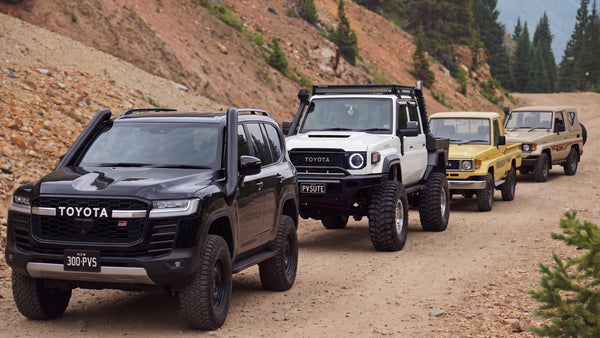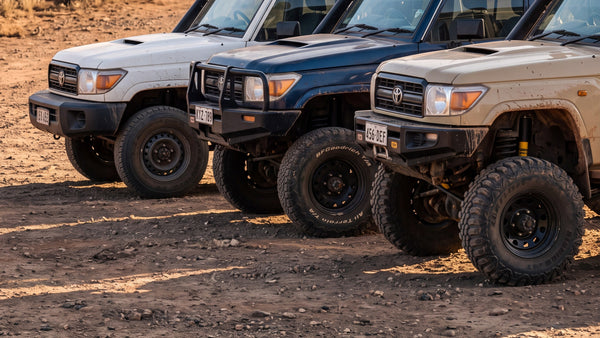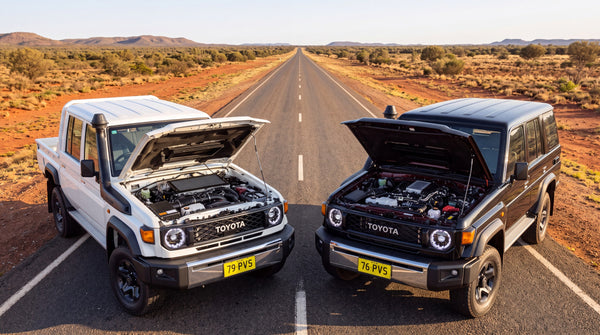



Since its global launch in 1984, the Toyota LandCruiser 70 Series has become one of the most enduring working vehicles on the planet. It's sold across Australia, the Middle East, Africa, South America and Japan, and buyers in each of those regions often get a fundamentally different vehicle under that familiar boxy skin. Engine families, transmissions, body configurations and equipment levels are all shaped by the demands, regulations and infrastructure of each local market. The version you know here is one chapter of a much longer story.
Australia's MY26 range is now standardised around the 2.8-litre four-cylinder turbo-diesel with AdBlue, and the 4.5-litre V8 era is behind us. So it's worth stepping back to see how varied the 70 Series family really is.
At a Glance
- The 70 Series has been in continuous production since 1984, serving markets across six continents in distinct regional configurations.
- Gulf (GCC) markets get the 4.0-litre 1GR-FE petrol V6 in GRJ76 and GRJ79 codes, a variant Australia has never officially received.
- The 4.5-litre 1VD-FTV V8 turbo-diesel was a largely Australian-market signature, with many countries never receiving it at all.
- Japan dropped the 70 Series in 2004, ran a special 30th-anniversary edition in 2014-2015, then reintroduced it permanently in late 2023 with a 2.8-litre turbo-diesel automatic.
- Africa operates enormous 70 Series fleets for aid, mining and agriculture, predominantly powered by older naturally aspirated diesels such as the 1HZ.
The Gulf: petrol V6 country
Mention a petrol-powered 70 Series here and you'll get blank stares. In Gulf Cooperation Council markets the 4.0-litre 1GR-FE V6 petrol is a mainstream choice.
Sold under the GRJ76 and GRJ79 model codes, these wagons and dual-cab utes are built for a region where fuel prices have historically been low, petrol infrastructure is mature and buyers favour the refinement of a naturally aspirated petrol engine on long highway runs between cities. Diesel variants are sold across the GCC too, but the petrol V6 sits comfortably in the lineup in a way it never has here. If you're used to debating diesel tune maps and exhaust temperatures on a long tow, a factory V6 petrol 70 is a genuine surprise.
Australia: the V8 era and what comes after
The 4.5-litre 1VD-FTV single-turbo V8 diesel arrived in 2007 and became so closely tied to the Australian-market 70 Series that plenty of owners called it "the V8." Australia was one of its biggest markets globally, and the engine earned a following for its torque and its long-distance cruising.
What's less appreciated here is that many countries never got the V8 at all. It was far less a global standard and far more a regional fit.
That chapter has closed. Australia's current MY26 lineup is built around the 2.8-litre GD-series four-cylinder turbo-diesel with AdBlue emissions treatment, which brings the local 70 Series into line with stricter modern emissions standards while keeping the body-on-frame platform that has defined the nameplate for four decades.
Japan: a model that came home twice
Japan's relationship with the 70 Series is one of the odder stories in the model's history. Toyota quietly dropped it from the Japanese domestic market in 2004, leaving local enthusiasts without a new example for a decade.
In 2014, Toyota reintroduced the 70 Series in Japan for a limited run to mark the model's 30th anniversary, offering it with the 4.0-litre petrol V6 through to 2015. That limited return drew serious collector interest and sold out quickly.
Then in late 2023, Toyota brought the 70 Series back to Japan permanently, this time with the 2.8-litre turbo-diesel and an automatic transmission only. No manual, no V8, no petrol option: a deliberately modern, streamlined specification for a domestic market that has changed a lot since 2004.
Africa: the fleet that runs on 1HZ
If fleet numbers tell the story, Africa may be the most important 70 Series market of all. Aid organisations, United Nations operations, mining companies and agricultural enterprises across sub-Saharan Africa have relied on the 70 Series for decades, with fleets that number in the tens of thousands.
The engine most commonly associated with African operations is the 1HZ, a 4.2-litre naturally aspirated inline-six diesel that predates the V8 and the GD four-cylinder by a generation. The appeal is straightforward: mechanical simplicity, no complex electronics, and the ability to run on variable-quality fuel and be repaired with basic tooling in remote places. Australian buyers have debated the V8 versus the 2.8 for years. Much of Africa has kept the 1HZ running, and running, and running.
South America: adapting to what the road demands
South American markets have their own configuration mix, shaped by fuel quality variation, altitude, import duties and the demands of agriculture, resource extraction and frontier infrastructure. The 70 Series has found a home across Brazil, Peru, Bolivia and other markets, often in specifications that differ from both the Australian and Gulf versions.
Like Africa, the emphasis in many South American applications is durability and serviceability over outright performance. The 70 Series is engineered as a platform that can serve very different briefs.
One nameplate, many versions
The 70 Series isn't a single vehicle, it's a regional strategy. Toyota has kept the nameplate alive for over 40 years by fitting different powertrains, transmissions and specifications to suit the practical realities of each market.
If you're fitting out a 70 Series for touring or work here, the accessories and upgrades that matter are the ones matched to how you actually drive it, whether that's a quality head unit with offline mapping through apps like Newtracs or WikiCamps for remote navigation, or interior upgrades suited to long-distance travel.
The 70 Series that leaves a dealership in Riyadh, Nairobi, Tokyo or Sydney wears the same badge and reflects a very different set of priorities. That adaptability, more than any single engine or specification, is probably why the platform is still in production.