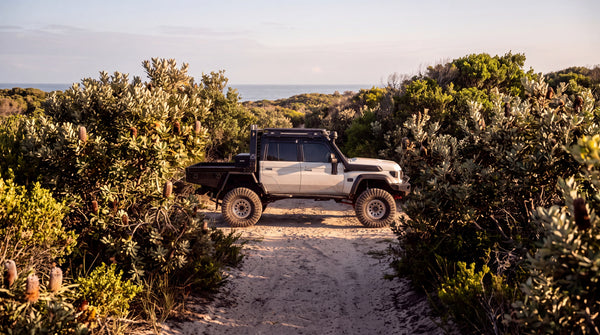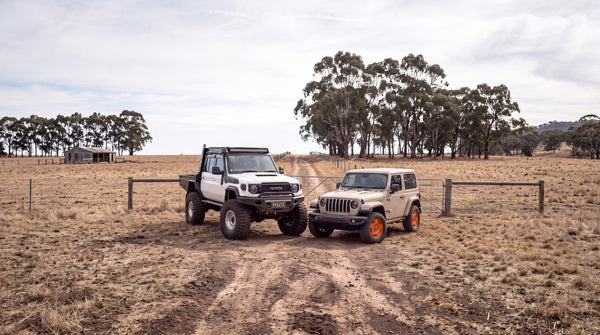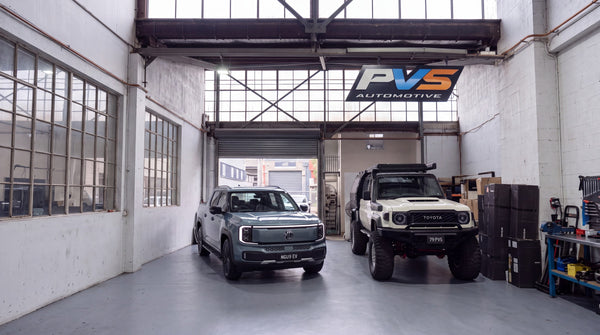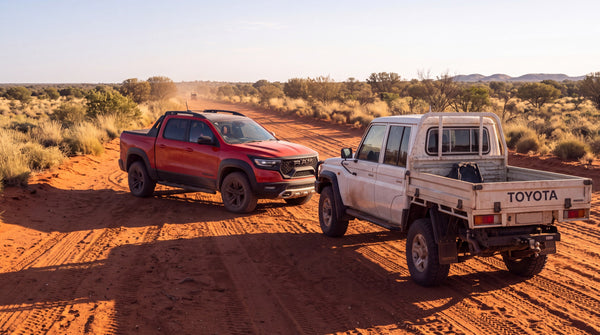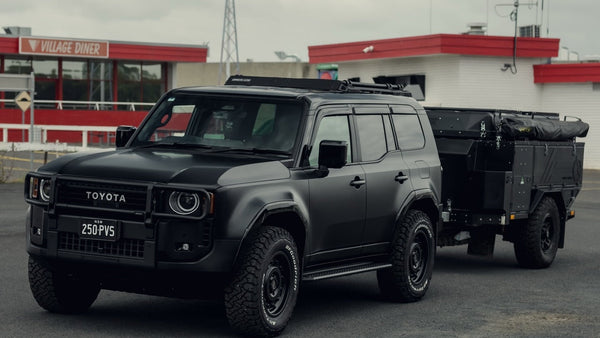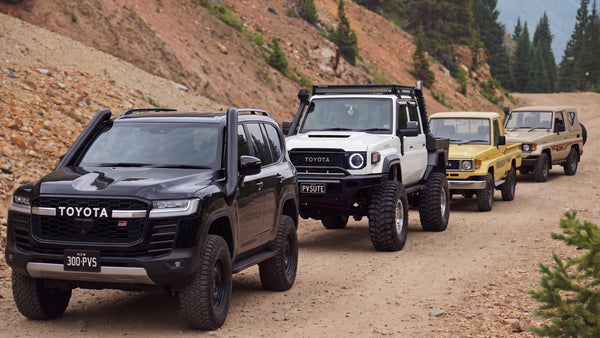



The Ineos Grenadier Trialmaster Station Wagon is now in a rolling long-term test in Australia, the first sustained real-world look at how it lives day to day. The report came from one outlet, written by Cristian Brunelli. He picked up a Scottish White example in late 2025 at a base price of $120,000, added $8,670 in factory options, and has been racking up kilometres across beach runs, suburban commutes and dirt tracks in Victoria. If you run a 70 Series and you've wondered how seriously to take this thing, the early results are worth a look.
The Grenadier exists because Sir Jim Ratcliffe, owner of Ineos and part of the Mercedes Formula 1 team, loved the old Land Rover Defender, watched it go lifestyle, and decided to build a replacement from scratch. What you get is a solid-axle wagon running BMW's B57 diesel engine, 550Nm of torque, with front and rear differential locks standard on the Trialmaster grade. Add a raised air intake, a NAS tow hitch and a ladder to get onto the roof. It looks vaguely like a classic Defender, but Brunelli is clear the driving experience has very little in common with one. The steering doesn't self-centre quickly, the speedo sits in the centre display rather than directly ahead, and the driver-side wiper misses a section of the windscreen near the A-pillar. None of that is fatal. It's the kind of thing that reminds you this is a brand-new platform with one generation of development behind it rather than forty years.
At a Glance
- Ineos Grenadier Trialmaster Station Wagon tested in Australia from late 2025, base price $120,000 plus options
- BMW B57 diesel engine produces 550Nm of torque; solid axles front and rear with standard front and rear diff locks
- Early off-road impressions from Lerderderg State Park are strong: good articulation, confident on steep rutted climbs without needing the front locker
- Recorded 11.7L/100km average fuel use across the first 4,780km of mixed driving
- Long-term test will include factory and non-factory accessories fitted progressively over several months
Where the Grenadier genuinely wins
550Nm from a BMW diesel is a serious number. The early fuel figure of 11.7 litres per 100km across nearly 4,800km of mixed use is competitive for a vehicle of this type.
The Recaro seats, front and rear, are a highlight. The rubber-floored interior with no carpet is easy to clean after a beach run or a muddy track. Ride quality on sealed and unsealed roads impressed the tester. Standard equipment on the Trialmaster grade covers the diff locks, the raised air intake and the access ladder, so you're not buying a base vehicle and then spending another fifteen thousand dollars to make it trail-ready.
For job-site use, regular highway travel, or a serious off-road vehicle that also does a reasonable school run, the Grenadier hangs together. The commuter experience is clearly strong. On the moderate terrain covered so far it's described as highly capable, with axle articulation that outperforms a lot of independent-suspension competitors. That matters.
What the LandCruiser 70 Series brings to this argument
Here's where it gets interesting if you own a 70 Series. The LandCruiser 70 has been in production since 1984. In Australia that means four decades of workshop knowledge, an aftermarket that's deep and genuinely competitive, and a parts supply chain that reaches into remote areas where a breakdown isn't a minor inconvenience.
You can put a four-inch lift and 35-inch tyres on a 70 Series using kits refined over multiple generations. GVM upgrades come from several suppliers with documented ADR compliance paths. Long-range fuel tanks, dual-battery systems, canopies, tray conversions, snorkels sized to the engine bay and full interior rebuilds in leather or vinyl are all available off the shelf or within a short lead time. The used parts market is mature. Break something on a remote track and another 70 Series owner within cooee has probably got the part or the knowledge to fabricate a fix.
The 4.5-litre V8 that powered the 70 Series for years is out of production, and its departure still stings for a segment of the market that valued its tunability, its simplicity and the sound of it under load. The current 2.8-litre four-cylinder with AdBlue is a capable engine and it runs cleanly, but the emissions system adds a layer of maintenance complexity in remote use that some owners have had to plan around. Neither engine is a B57 BMW diesel for refinement or on-road manners. That's a fair thing to say.
What the 70 Series has is platform depth no first-generation vehicle can match. The Grenadier is starting to build its own aftermarket, and the long-term test is explicitly including non-factory accessories as it progresses. That's a sign Ineos and its supporters understand what serious buyers want. But starting to build an aftermarket and having one aren't the same thing. On a $120,000 plus decision, what you can actually do to the vehicle over its life, and who can help you do it in the bush, isn't a small consideration.
The argument worth having
The Grenadier isn't a toy, and it isn't a Defender in a costume. It's a serious attempt at a purpose-built heavy 4x4 for people who use one, and the early long-term evidence suggests it's doing the fundamental job. The 70 Series faithful will point to aftermarket depth, the resale curve, parts availability and the raw familiarity of a platform sorted over decades. The Grenadier camp will point to 550Nm, Recaro seats, a better on-road experience and a clean-sheet design that doesn't carry the compromises of a platform drawn up in the 1980s.
Both positions hold up. Settle two things in your own mind before you write a cheque either way: how far from a parts supplier you're planning to go, and how long you plan to keep it. The 70 Series answer to both is hard to argue with. Whether the Grenadier can get there over time is what this long-term test is trying to answer, and it's worth following.