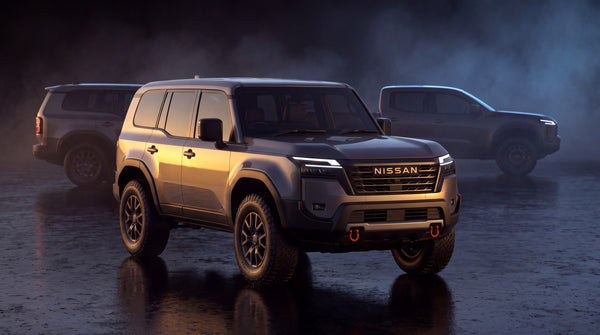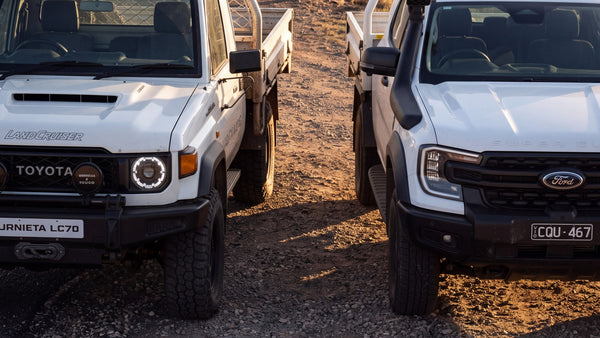



Nissan's new Navara now sits within a few thousand dollars of the HiLux SR5, at somewhere between $66,000 and $68,000 drive-away, and the spec sheets are just as close. A local test in July 2026 ran the two back-to-back. That's new territory for this segment.
What that tells you matters beyond the dealership floor. The 70 Series isn't a HiLux and it isn't a Navara, but for tens of thousands of Australian owners it's the reference point every capable dual-cab gets measured against. Knowing what the new Navara can and can't do tells you why that reference point has held for four decades.
At a Glance
- Both the HiLux SR5 and Navara ST-X sit at around $66,000 to $68,000 drive-away and share a 3500kg tow rating with around a tonne of payload.
- The HiLux runs a 2.8-litre turbo-diesel with a 48-volt mild-hybrid system producing 500Nm; the Navara counters with a 2.4-litre bi-turbo diesel producing 470Nm.
- GVM and GCM figures are close but the HiLux retains a small payload advantage when towing at the legal combined limit.
- The new Navara was developed by Premcar on a platform shared with the Mitsubishi Triton, and it backs that with full-time four-wheel drive and a 10-year warranty.
- The LandCruiser 70 Series remains the benchmark for long-haul capability, aftermarket depth and platform longevity in the Australian 4x4 market.
What Nissan has actually built
The new Navara isn't a rebadged Triton. Nissan handed the shared Renault-Nissan-Mitsubishi Alliance platform to Premcar, the Australian engineering firm that turned the D23 Navara Pro-4X Warrior into one of the best-regarded factory-enhanced 4x4s in the segment.
The brief was to give the new model its own character, and by most accounts it worked. The Navara drives like a Navara, not a Triton with different sheetmetal.
If you're buying a working ute, the ST-X grade just below the flagship Pro-4X is the one to watch. It arrives with leather-accented trim, a power-adjustable driver's seat and a tub liner included. Toyota holds that gear for higher grades or the options list on the equivalent HiLux SR5.
The Navara also comes with full-time four-wheel drive and a 10-year warranty with longer service intervals. If you run a fleet or a small business and you're counting whole-of-life costs, both of those matter.
The numbers: close, but not equal
Both utes produce 150kW. The HiLux's 2.8-litre turbo-diesel, now backed by a 48-volt mild-hybrid system, develops 500Nm from 1600rpm through to 2800rpm. The Navara's 2.4-litre bi-turbo diesel delivers 470Nm. Both rate a 3500kg braked tow capacity and carry around a tonne of payload. On the headline figures you could flip a coin.
The detail that matters sits in the GVM and GCM. The HiLux SR5 is rated to 3120kg GVM with a 6300kg GCM. The Navara ST-X comes in at 3190kg GVM with a slightly lower 6250kg GCM.
Tow a 3500kg trailer and the HiLux keeps around 645kg of combined payload headroom. The Navara holds around 579kg. If you work at the legal limit of combined mass, that gap isn't trivial.
Where the 70 Series conversation starts
None of this counts against either dual-cab. Both are impressive working vehicles in 2026, and either one will serve you well as a tradie or a weekend traveller.
The argument changes when you ask what you can do to the platform over the life of ownership. On that question the LandCruiser 70 Series is in front.
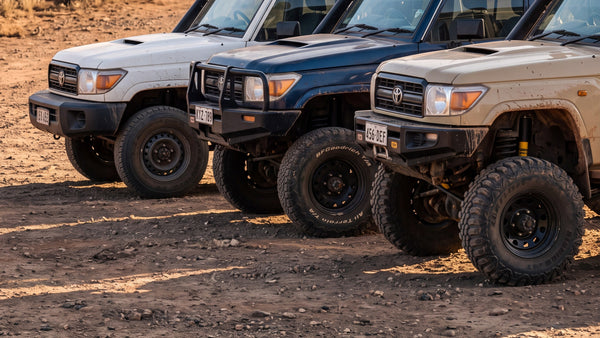
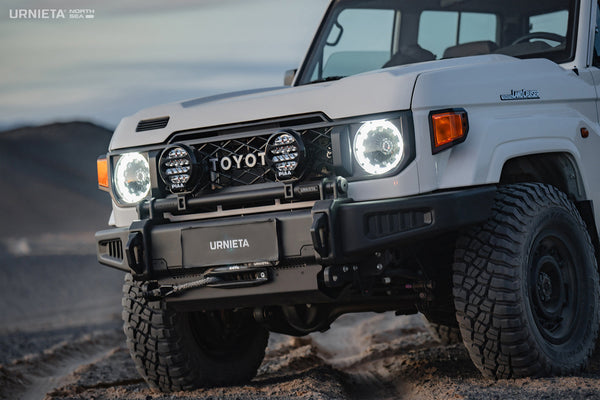
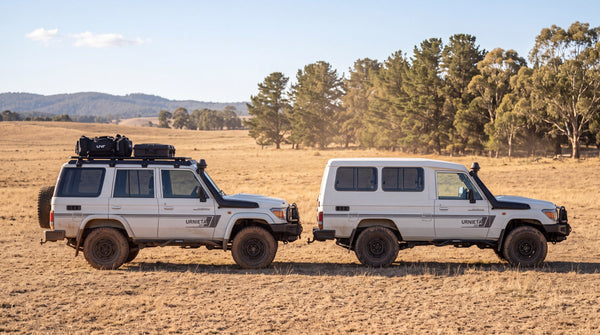
The 70 Series body-on-frame platform has been in continuous Australian production and continuous aftermarket development for over forty years. No other 4x4 sold here matches that modification ecosystem for depth or geographic reach.
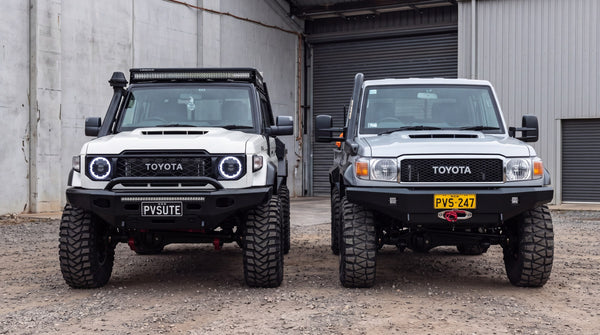
A four-inch suspension lift on 35-inch tyres with a GVM upgrade is a well-documented, ADR-compliant process, with multiple engineering certificate pathways available nationally. Long-range fuel tanks from several Australian manufacturers bolt straight in. Dual-battery systems, canopies, custom trays, snorkels and full interior rebuilds have been done thousands of times, with fitment knowledge spread across every rural town and metropolitan workshop in the country.
You can modify the Navara and the HiLux too. Both have growing aftermarket support, and suspension options are already available for the new Navara given its shared Triton underpinnings. The 70 Series aftermarket isn't a question of what's available: it's what has been refined over three decades of real-world use in Australian conditions, with parts on the shelf at a rural Repco, not just on order from a metro fitment specialist.
The V8 that's gone and the 2.8 that replaced it
The engine question runs underneath this whole comparison. The 4.5-litre V8 turbo-diesel that powered the 70 Series for years is out of production, replaced by the 2.8-litre four-cylinder with AdBlue in current models.
That transition still splits 70 Series owners, and comparisons like this one reopen it. The 2.8 with AdBlue brings the 70 Series into line with emissions standards, and it changes the character of the platform in ways long-term owners still argue about.
Neither the HiLux nor the Navara has that conversation to have. Both are modern, efficient four-cylinder diesels designed from the ground up for current standards. The HiLux's mild-hybrid setup makes it smoother at low revs and more fuel-efficient on the highway than earlier versions. The Navara's bi-turbo setup is built for strong low-end response. If you commute city to country or watch a fleet fuel bill, both have a real argument over the 70 Series's running costs.
So has Nissan finally done it?
Closer than before, but probably not yet. The HiLux's sales dominance in Australia is built on something no spec sheet shows: thirty-plus years of fleet operator confidence, parts availability, resale value certainty and the odds that the vehicle next to yours on a remote track is also a HiLux. The Navara's 10-year warranty and Premcar suspension tuning are meaningful, and trust is built over model cycles, not press launches.
If you own a 70 Series, the more interesting version of this argument isn't HiLux versus Navara at all. It's whether either of these utes, at around $66,000 to $68,000 drive-away, gives you better value than a 70 Series when you genuinely work and travel hard in the Australian bush.
The dual-cabs win on comfort, technology, fuel economy and commuting manners. The 70 Series wins on platform depth, modification headroom, parts longevity and the mechanical simplicity that matters when the nearest town is four hours away and you're fixing it yourself.
There's no single right answer there. The new Navara has made the argument more interesting than it's been in years. Drop your position in the comments below.
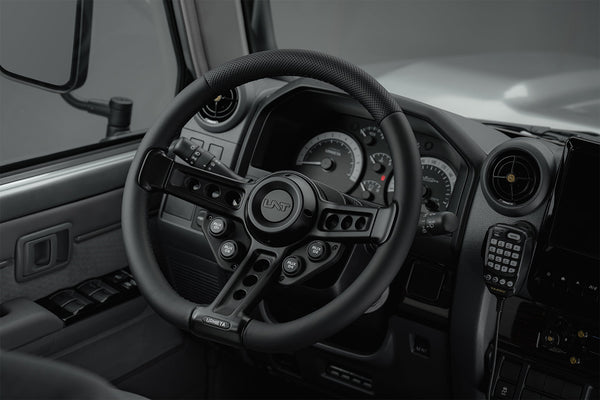
PVS Automotive stocks steering wheel kits, head units and interior trim for the N70 HiLux platform if you're already in the Toyota family.