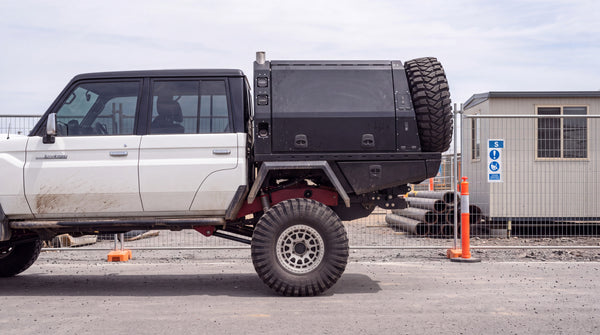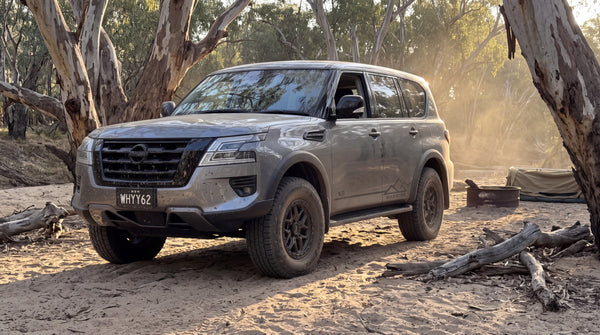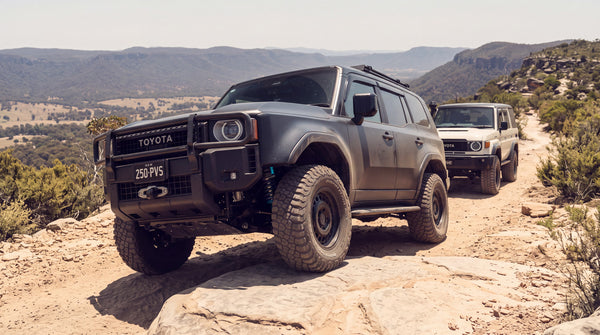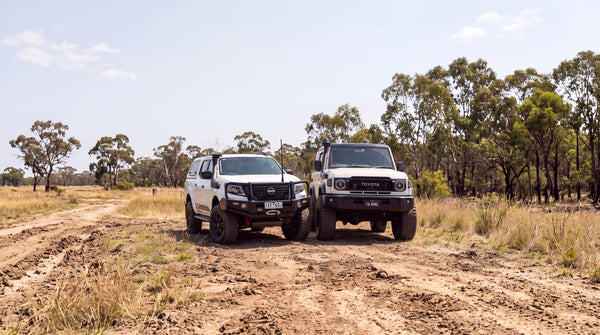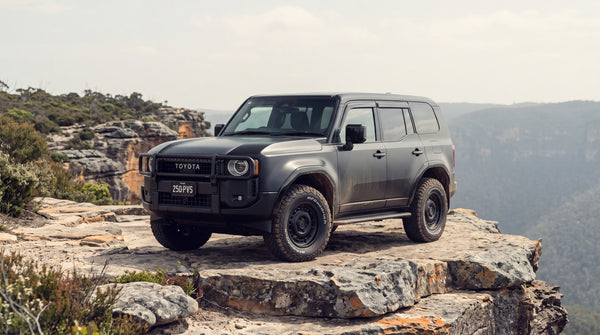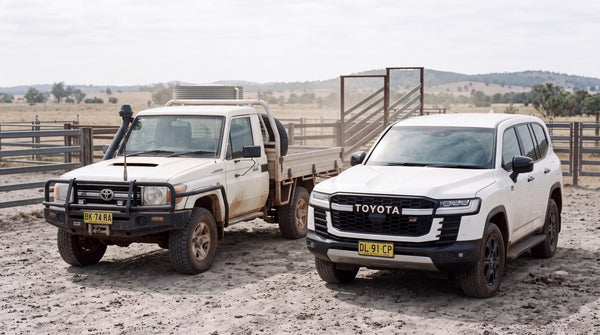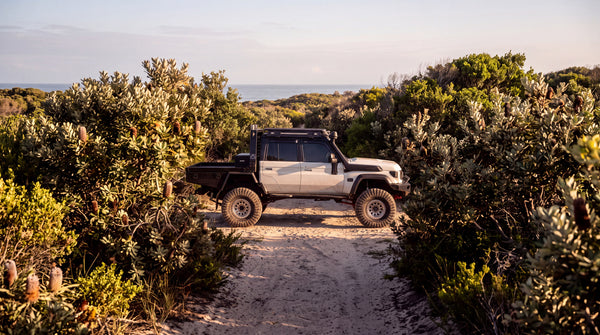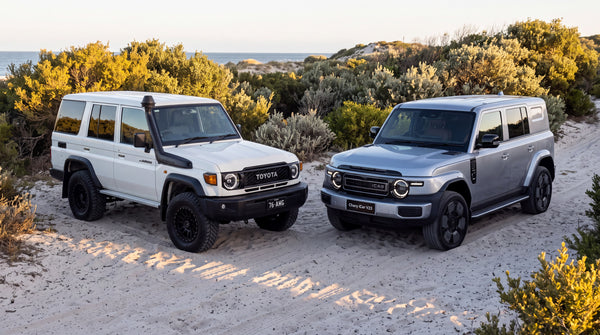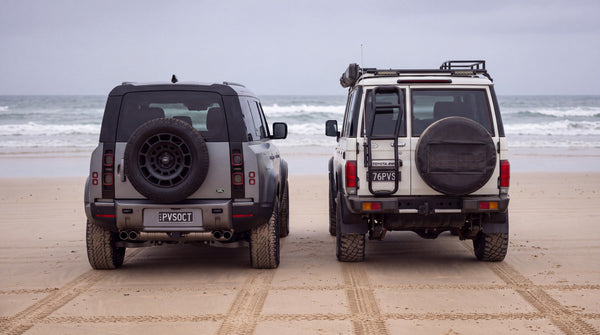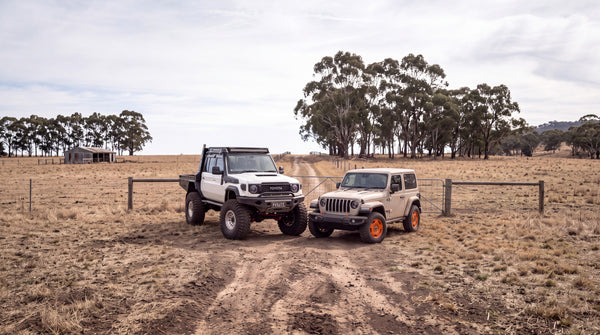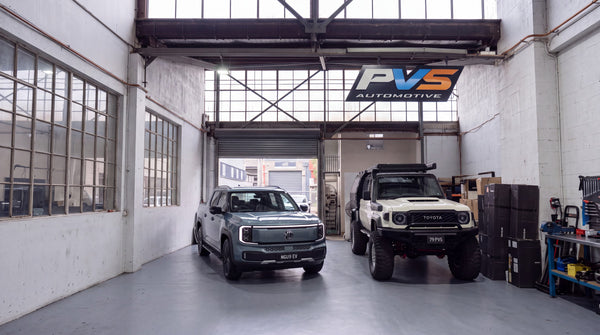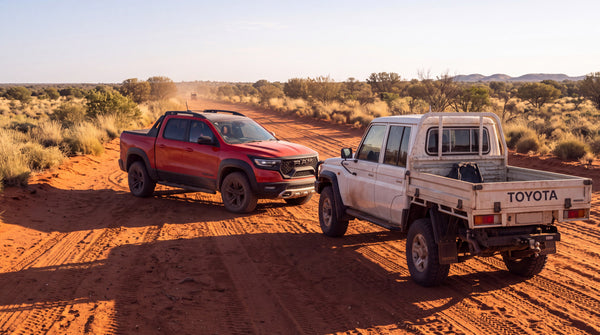



Land Rover has revealed the Defender Dakar, a road going version of the D7X-R that won the Stock class at the 2026 Dakar Rally. It carries a 4.4 litre twin turbo V8 making 635PS, which is 626 horsepower or about 467kW, and 750Nm. Toyota's flagship at the same moment is a hybrid V6, and the 70 Series V8 is gone.
The version doing the rounds is that Land Rover beat Toyota at Dakar and then beat it again in the showroom. Both halves are wrong, and the numbers underneath are more interesting than the story.
At a Glance
- Defender Dakar: 4.4 litre twin turbo V8, 635PS (626hp, about 467kW) and 750Nm, eight speed automatic with high and low range
- 35 inch all terrain tyres on 20 inch forged wheels, coil suspension with Bilstein dampers, raised ride height and wider track
- Limited run, numbers and price not announced, reservations early 2027, full specification held back until the 2027 Dakar
- 300 Series Performance Hybrid: twin turbo 3.4 litre petrol V6 plus electric motor, 341kW and 790Nm combined, from $156,060, on sale here mid 2026
- That's 114kW and 90Nm up on the diesel and the most powerful LandCruiser ever sold in Australia
- The 4.5 litre turbo diesel V8 in the 70 Series is retired, last deliveries through the end of 2025, and the 2.8 litre four cylinder carries the range

The 626 horsepower V8 wins desire and can't tell you what it costs
One number is worth sitting with. The race car that actually won the class was restricted by Stock class regulations to roughly 394 horsepower. The road car Land Rover is now selling off the back of that win makes 626. The showroom version is comfortably more powerful than the thing that did the winning.
The hardware is real: carbon fibre bonnet and air intakes, roof mounted light pods, extended arches with exposed rivets, two plus two seating with race seats and optional four point harnesses. It's a halo, built and sold as one, and Land Rover is very good at it right now.
What it doesn't have is a price, a build number or a full specification. Reservations open in early 2027 and the spec stays hidden until the 2027 Dakar. You're being asked to want something before you're told what it is or how many exist.
What the Dakar result actually was
Land Rover won the Stock class, taking first, second and fourth on the class debut. Stock is the production based category, where the cars sit far closer to what you can buy and the power is pegged back to suit. It's a real result and a hard one, run over nearly 8,000 kilometres.
It wasn't the outright Dakar win. That went to Nasser Al-Attiyah and Fabian Lurquin in a Dacia Sandrider, the sixth of Al-Attiyah's career. Toyota was in the Ultimate class with the Hilux and was quick in it. Henk Lategan won stages and led the rally outright after stage four, then lost a wheel bearing on stage eleven while running second and finished 21st. Seth Quintero came home ninth. Yazeed Al-Rajhi, the defending champion, was out on stage four.
So Land Rover and Toyota didn't go head to head, and Land Rover didn't beat Toyota to a Dakar title. They were in different categories, chasing different things. Anyone telling you the Defender beat the LandCruiser at Dakar is selling something.
The hybrid V6 wins the numbers and loses the cylinder count
The premise doing the rounds is that Toyota lost its V8 on the 300 Series. That isn't quite right either. The 300 Series never had one. When it replaced the 200 Series in 2021 it arrived with a 3.3 litre twin turbo V6 diesel, and the 4.5 litre V8 diesel that the 200 carried didn't make the jump.
The 300 Series Performance Hybrid pairs a twin turbo 3.4 litre petrol V6 with an electric motor for 341kW and 790Nm combined, from $156,060, on sale here mid 2026. That's 114kW and 90Nm up on the diesel and the most powerful LandCruiser ever sold in Australia. It's a lot of engine. It's just not eight cylinders.
The cost is the story, not the output. Nobody queues for a hybrid because of what won a rally class, and Toyota has no halo to point at. The 300 hybrid is a towing and touring argument, the FJ is a different pitch, and the 70 Series sells on what it has always sold on, which is that it'll still be here in twenty years.

Where the V8 that mattered to you went
The 4.5 litre turbo diesel V8 in the 70 Series was retired after 17 years on sale here, with the last deliveries running through the end of 2025. The 2.8 litre four cylinder carries the range now, and it picked up a manual gearbox on the way through. Values on the last of the V8 utes have behaved exactly as you'd expect, which we covered in our piece on V8 collectibility.
Land Rover is doing what Toyota used to do without trying. It's building a halo, winning something with it, and selling a road car that borrows the story. Toyota is optimising for the thing its buyers actually do, which is work and distance. Ask again in five years which of the two is easier to get parts for in Bourke.
The verdict for a 70 Series owner
Take Toyota's side on engineering and Land Rover's side on marketing, then stop chasing peak power in either direction. Practically, nothing changes tomorrow. The 2.8 is the engine, the aftermarket for the 70 Series is deeper than it has ever been, and the reason you build these was never peak power.
What it does change is the second hand market. Every time a manufacturer announces a limited run V8 halo car, it reminds the market that the big naturally aspirated and lightly stressed engines are finished. The last V8 79s are already being treated as keepers. If you own one, you're holding a vehicle Toyota can't replace, and the value of a tidy, sorted, well built example isn't going backwards.
If yours is the one that gets kept, your money goes further in the cabin and on the gear than it does chasing power. That's the same conclusion we reached in our long term Grenadier comparison, and nothing about a 626 horsepower Defender changes it.