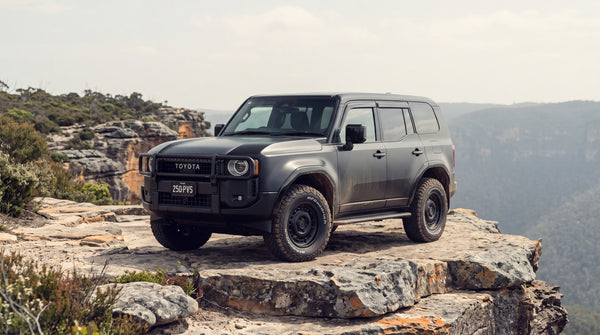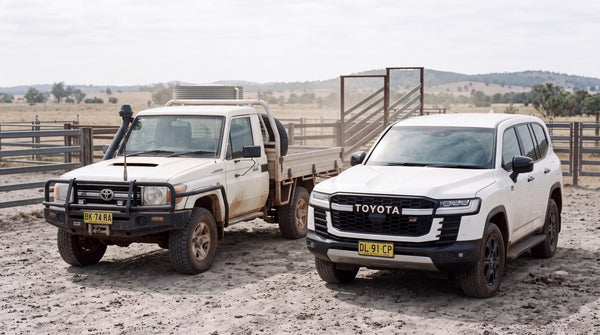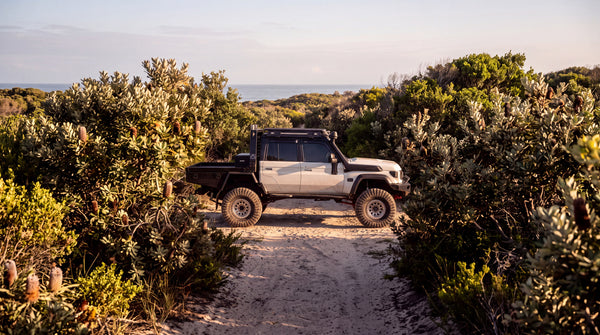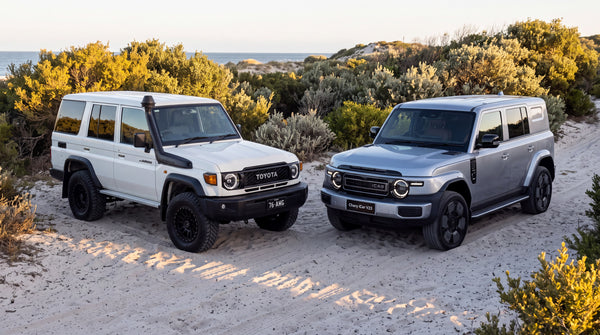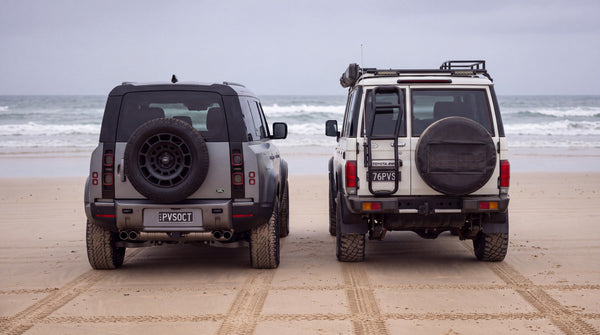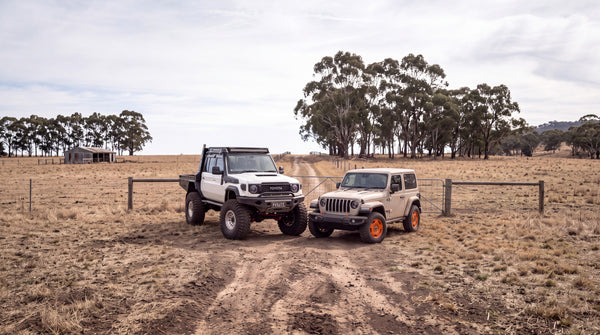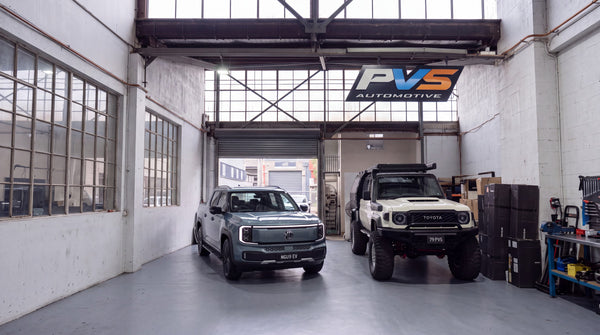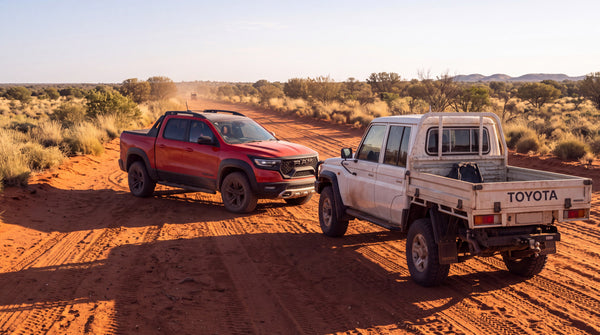



The comparison only exists because of money: what a G-Class costs would buy a new 79 and a very serious build on top of it. The two could not be further apart in intent. One arrives complete, trimmed and warranted. The other arrives as a platform that's been in production since 1984, with thirty years of aftermarket behind it and an owner who intends to change most of it.
The argument is worth having properly, because the G-Class doesn't deserve the sneering it usually gets from 4x4 forums. It's a ladder-frame vehicle with three locking differentials, which is more locking hardware than a 70 Series leaves the factory with. It has far more power than anything Toyota ever put in a 79, a cabin finished to a standard the 70 has never attempted, and safety equipment the 70 Series doesn't have. On a long highway run it's quieter and faster and less tiring. None of that is in dispute here.
What the 70 Series actually is
The 70 Series launched in 1984 as the 40 Series replacement, and the basic architecture has been carried forward rather than replaced. Front leaf springs gave way to coils with radius arms and a panhard rod in 1999. The rear is still on leaves. It runs a live axle at both ends, which is the single most important fact about modifying one.
The 4.5 litre 1VD-FTV V8 arrived in 2007 and finished in 2024 at 151kW and 430Nm. The 2.8 litre 1GD-FTV four-cylinder came in late 2023, 150kW and 500Nm with the six-speed automatic, and from MY26 the range carries AdBlue. Since July 2026 only automatic variants are orderable in Australia. So the V8 is now a used-market proposition and the 2.8 is what a new buyer gets, with the emissions hardware that comes with it.
Where the money goes on each one
Spend it on a G and you're buying the badge, the finish and the engineering that came with the vehicle. That's a legitimate thing to buy. Nobody who buys one is confused about what they've bought.
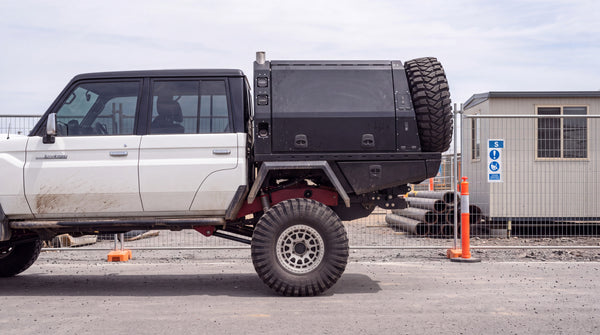
Spend the same on a 79 and almost none of it goes to Toyota. It goes to a four inch lift on 35s, a GVM upgrade, a tray or a canopy, a snorkel, long range tanks, dual batteries and a full interior rebuild. Every one of those is a known quantity on this platform. There are engineers who have signed off the suspension, fabricators who have built the tray, and a queue of people who have done the same combination before you.
The live axles are the reason the lift is well understood. The work is castor correction at the radius arms and a panhard rod that puts the axle back under the guards, and none of the independent front end compromises apply. That's a thirty-year-old advantage that hasn't gone anywhere.
Serviceability is the part that decides it
The platform has been in production for more than forty years and the current drivetrains have been in the field long enough to be understood. That means the parts and the people who know them are widespread rather than concentrated in a capital city. A workshop in a regional town has seen a 79 before. It's the practical difference between a problem that stops your trip for a day and a problem that stops it for a fortnight while something is freighted in.
Modern machinery is more complicated than what it replaced, and that's not a criticism; it's just the trade. More systems means more capability and more comfort, and it also means more that has to be diagnosed with the right tool by someone who has the training. When you're a long way from a dealer, that changes the maths. A vehicle with a strong warranty is worth a great deal when you're 40 minutes from the dealer and worth much less when you're four days from one.
Give the G its wins, then take the side
If the driving is mostly bitumen with serious off-road work at the end of it, the G-Class is the better vehicle as it arrived. It's more comfortable, it's far quicker, and its off-road hardware is real. Anyone who calls it a soft-roader hasn't looked at the diff locks.
But a touring build is a series of decisions, and the 70 Series is the better place to start making them. Payload is the one that catches people out, and a GVM upgrade on a 70 is ordinary work rather than an engineering adventure. A tray opens the vehicle up to whatever you need to carry. Long range tanks are a well-trodden fit. Dual batteries and a fridge are so standard on this platform that the wiring routes are common knowledge.
The 70 Series is the pick, and not because the G-Class is a lesser vehicle. It's the pick because the 70 is the one you can change, fix and keep changing for twenty years, anywhere in the country, with parts that are widely stocked. That's what the money buys, and it's a more useful thing to own than a finish.
We build interior and control parts for the 70 Series, which is the part of the argument we have a stake in, and the rest of it stands on its own.