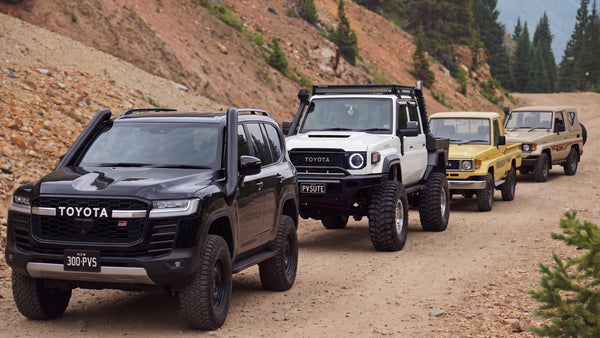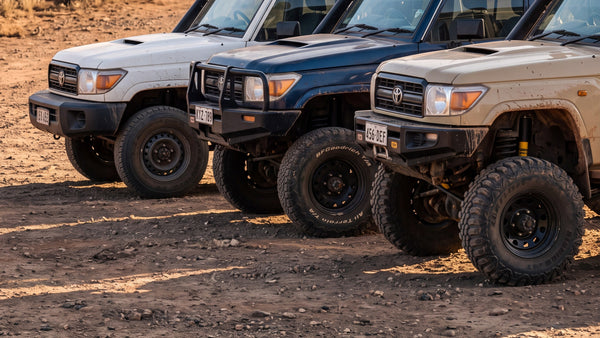



Toyota is planning to hold its mainstream models in production for close to a decade before giving them a full redesign, according to a report in Japan's Nikkei business newspaper. The shift is significant: the company has typically worked on a roughly seven-year cycle. Stretching that to nine years isn't a small adjustment. It's a structural change to how Toyota brings new product to market, and the LandCruiser 70 Series sits right at the centre of it.
The reason Toyota is making the move isn't complicated. Demand for models like the 70 Series has been so strong that wait times blew out far enough for Toyota to suspend new orders entirely. That's happened more than once on the 70 now, and it happened to the Camry in Australia in 2023. When a vehicle sells faster than you can build it, there's no commercial pressure to replace it.
At a Glance
- Toyota extending mainstream model cycles from roughly seven years to nine
- Software updates via its Arene platform will replace many mechanical refresh milestones
- The 70 Series has already had orders suspended due to demand outrunning supply
- Toyota plans to charge for some over-the-air updates, with a cooling function on GR models already live as a paid download
- Dealers in Japan have pushed back, concerned about margin erosion under the new flexible pricing model
What the software shift actually means
Instead of new bodywork, new chassis geometry or a new drivetrain every seven years, Toyota's plan is to evolve its vehicles digitally. The company's Arene software platform handles over-the-air updates across powertrain calibration, safety systems and multimedia. Hajime Kumabe, CEO of Toyota's software company Woven by Toyota, which develops Arene, has described that business as a tugboat pulling Toyota forward.
Some of those updates are already paid. GR Yaris and GR Corolla owners can buy a downloadable cooling function that manages engine temperatures under hard driving. Subscription-based services are also being considered, though Toyota will have watched other manufacturers take real damage from that conversation and it hasn't committed publicly to what the model looks like beyond cars already in the programme.
The stated goal is for Toyota to generate around 40 per cent more profit from sources other than new-car sales by 2030. Software is a large part of that. It also frees up engineering resources to chase electrification, which remains a priority even as Toyota keeps hedging its battery timeline relative to competitors.
What it changes for the 70 Series specifically
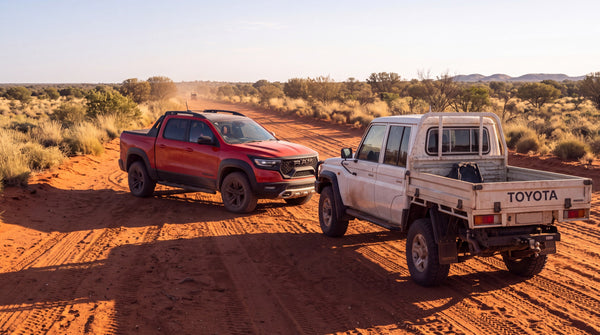
The 70's architecture is already old by any mainstream measure. The platform has been in continuous production for decades, and it has never been the thing you bought for software sophistication. You bought it because it goes places other wagons don't, carries loads others won't, and survives conditions that end careers for lighter vehicles. That hasn't changed. What this news confirms is that Toyota has no commercial reason to rush a replacement, and every reason to keep building what's already selling faster than it can be shipped.
For anyone running a 70 Series, that's mostly good news. The aftermarket behind this platform is the deepest in the country. A 4-inch lift on 35s is a weekend job with parts sourced locally from half a dozen suppliers. GVM upgrades are well-documented, legally supported and available for every body variant. Trays, canopies, snorkels, long-range tanks, dual-battery setups and full interior rebuilds are all supported by thirty-plus years of fitment knowledge across Australia. If you break something on a remote track, someone has a part.
That depth of support doesn't appear overnight on any platform, and it won't transfer automatically to whatever comes next. If Toyota holds the current 70 in production for another cycle, the aftermarket has more time to mature further. Fitment knowledge spreads further, and the pool of secondhand components grows. Used 70 Series values have held strong precisely because the platform doesn't age out of relevance: this strategy extends that dynamic.
The honest trade-off
The 2.8-litre four-cylinder with AdBlue is a capable engine. It makes strong torque at low revs, it's cleaner than the V8 it replaced, and it keeps the 70 in compliance with tightening emissions rules. But it's not a software-defined powertrain. Over-the-air calibration tweaks can optimise what's already there; they can't change the fundamental character of the drivetrain or the way the 70 rides over corrugations.
That matters because the gap between a 70 Series and a newer, more software-connected vehicle will widen in some areas even as Toyota holds its other models in place. Rival platforms are already offering connected services, adaptive drive modes and driver assistance packages that update automatically. A nine-year cycle without major mechanical changes means the 70 won't close that gap on its own. Whether that gap matters to you depends entirely on what you're using the vehicle for.
If your 70 spends most of its life on the Gibb River Road loaded to GVM with a canopy and a fridge, the absence of over-the-air updates isn't the thing keeping you up at night. If you're commuting five days a week and occasionally heading bush, you'll feel the comfort and connectivity difference more sharply. That's the honest version of the trade-off and it's worth saying plainly: Toyota is betting that work and off-road capability matter more to 70 Series buyers than digital features, and the order books suggest they're right.
What to watch
Dealers in Japan have already pushed back on the plan, worried that longer cycles combined with more flexible pricing will squeeze their margins. How that tension resolves will shape what options and pricing look like here. It's also worth noting that Toyota suspending orders, extending cycles and managing supply tightly has historically kept residual values high, which is not a bad position to be in if you're buying now or selling in four years.
The 70 Series isn't getting replaced soon. Your build isn't going to be orphaned by a platform swap. That's a real win for anyone who's put money into a serious setup. The argument worth having is whether Toyota's software-first refresh strategy can keep the 70 genuinely competitive on comfort and connectivity, or whether it widens the gap to the point where a different vehicle starts making sense for the mixed-use buyer. That's the question Toyota hasn't answered yet.