


A Ram mid-size ute for Australia isn't a rumour anymore, but it's still a long way from being a reality. Amy Augustine, head of product and sales at Ram Trucks International, visited Australia for the first time to help launch the Hemi V8-powered Ram 2500 Warlock, and she was straightforward about what she saw: a mid-size ute market that's too large to ignore. Jeff Barber, Ram Trucks Australia's general manager, went further. "Absolutely, if it's available to us, it will sell very well here," he said, though he was careful to note the Dakota name may not be what ends up on the badge.
Stellantis has confirmed the new mid-size pickup enters production in 2028 at the Toledo Assembly Complex in Ohio, the same plant that builds the Jeep Gladiator sold here. A starting price below US$40,000 has been indicated in the United States, which works out to roughly A$56,400 before taxes and on-road costs. Body-on-frame construction is expected. Powertrains haven't been confirmed. A high-performance SRT variant has been flagged, which would put it up against the Ford Ranger Raptor in a way no competitor has managed yet. Right-hand drive hasn't been confirmed, and whether Walkinshaw Automotive would handle local conversion, as it does for the Ram 1500, 2500 and 3500, hasn't been settled either.
At a glance
- Ram's Australian team says a mid-size ute "would sell very well" locally, subject to availability and right-hand-drive confirmation
- Stellantis has confirmed 2028 production at the Toledo, Ohio plant, with a US starting price below A$56,400
- Body-on-frame construction expected; powertrains unconfirmed; a high-performance SRT version is flagged
- The Ford Ranger leads 2026 Australian sales with 32,796 units to the end of August; the HiLux sits at 32,161
- The LandCruiser 70 Series competes in the same broad conversation but on entirely different terms
Why the segment numbers matter
The Ford Ranger has been Australia's best-selling vehicle for three consecutive years, taking the spot the HiLux held since 2016. Figures to the end of August 2026 show the Ranger on 32,796 deliveries and the HiLux on 32,161. Together they've been the country's two most popular vehicles for more than a decade. The Ram 1500, for context, has led full-size pickup sales in Australia for eight years running but recorded 2,674 sales in 2025. The mid-size segment is a different universe in volume terms, and that's exactly why Ram wants in.
For a Dakota, or whatever name it carries, to reach Australia at all, Stellantis still needs to confirm right-hand-drive production, and Walkinshaw would need to be set up for a new platform. None of that is guaranteed. 2028 is the production start date in the US, so you're looking at 2029 at the very earliest for any realistic local conversation, and probably later.
Where the 70 Series sits in this
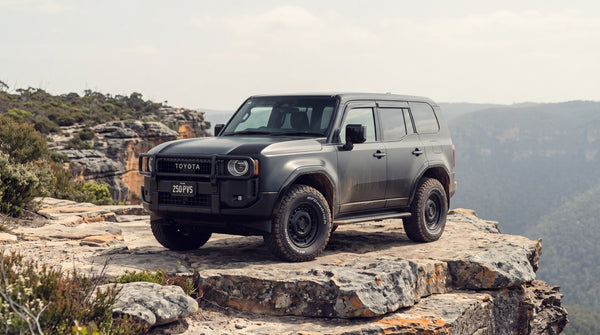
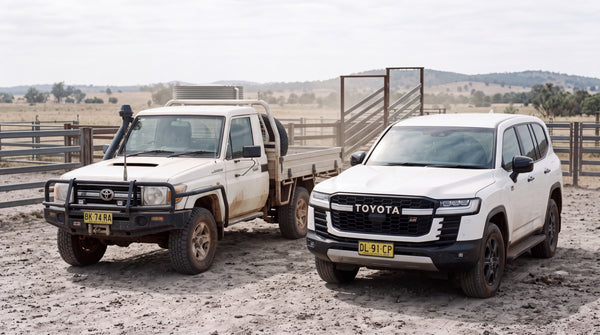
The LandCruiser 70 Series isn't really a Ranger rival. It never has been. The 79 dual cab competes for the same general buyer category, the person who needs a capable, go-anywhere workhorse, but the comparison stops there pretty quickly.
The 70 Series runs a 2.8-litre four-cylinder diesel now, with AdBlue, producing 150kW and 500Nm. The outgoing 4.5-litre V8 turbo-diesel is out of production but still widely sought on the used market. Neither of those is a commuter powertrain and neither is meant to be. The 70 Series is body-on-frame, live axle front and rear, with a proven transfer case, a suspension geometry that has been refined over four decades, and a parts and aftermarket network that covers the entire country, including places where no other brand has a dealer or a parts supplier within five hundred kilometres.
A Ram Dakota will arrive with real engineering behind it. Stellantis builds serious off-road hardware, and the Jeep Gladiator is no embarrassment in the dirt. A high-torque SRT variant would be quick, and a US-spec starting price in that range would undercut a specced-up 79 dual cab. Those are real points in its favour, and it would be a dishonest article that glossed over them.
What the 70 Series can do that takes decades to replicate
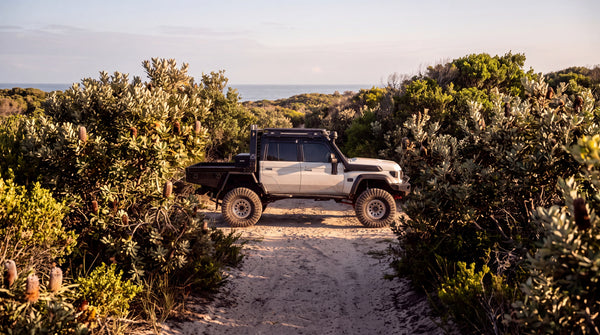
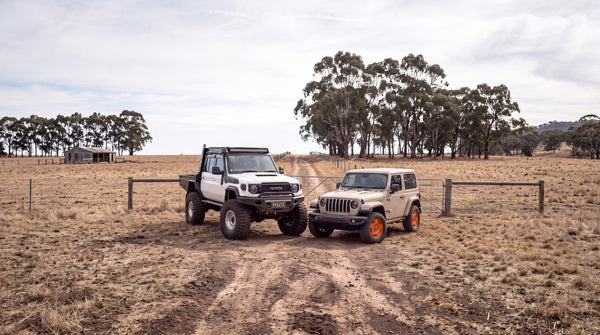
Run a 70 Series for long enough and you'll understand what the aftermarket depth actually means in practice. A four-inch lift on 35-inch tyres is a straightforward build with multiple suspension kit options from brands that have been refining fitment on this platform for years. GVM upgrades are available and ADR-compliant. Long-range fuel tanks, dual-battery systems, canopies, trays, snorkels, full interior rebuilds with leather or carbon trim, steering wheel controls, headunit upgrades: every one of those has a mature aftermarket behind it, with fitment guides, forum knowledge going back to the early 2000s, and workshops in every capital city and most regional centres.
That isn't a knock on the Dakota. It's a description of what thirty-plus years of continuous production buys you. A brand-new platform entering production in 2028 won't have that ecosystem on day one, or year three, or possibly year ten. The Ranger has been on sale here for well over a decade and its aftermarket is still maturing compared to the 70 Series. A Dakota would start from further back.
There's also the resale side. The 70 Series holds value in Australia in a way that's almost irrational by the standards of any other segment. Used V8 examples are still trading at prices that reflect genuine scarcity demand. A new entrant has to earn that trust over time, and time is the one thing a 2028 production start doesn't give you.
The honest verdict
If the Dakota arrives in right-hand drive and Walkinshaw can convert it at a price that makes sense, it will sell. The segment numbers alone guarantee that. A well-sorted American body-on-frame ute with an SRT option is a compelling product on paper, and Ram's reputation for torque is real.
But if you're weighing it against a 70 Series for serious work or serious travel, the platform you're looking at has been optimised for Australian conditions since before some of its prospective buyers were born. The aftermarket for a 79 or a 76 wagon isn't something a new entrant matches in a product cycle or two. You can build a 70 Series into almost anything you need it to be, with proven parts, known fitment, and suppliers who have been doing it for decades.
The Dakota might be a great ute. The 70 Series is already a known quantity, and that's a different kind of argument altogether. Drop your take in the comments: would you trade proven depth for something new out of Toledo?