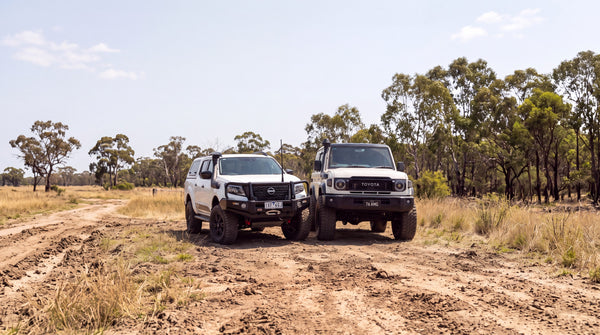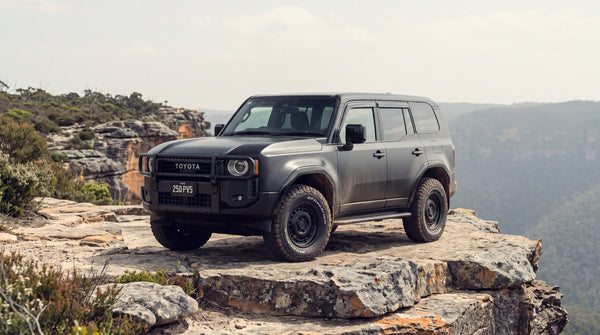



The owner of this Prado came to the 250 Series the way a lot of Australian off-road builders do: through a car that got discontinued. The previous wagon was a modified Toyota Fortuner, built to a level that regularly surprised people on rocky tracks. When Toyota pulled the Fortuner from the Australian market, the owner didn't look sideways at the competition. They bought a Prado Altitude and immediately started treating it as a project.
The result is a build that's worth paying attention to, not because it's exotic, but because it makes a very specific argument: that a modern family-sized wagon, kept deliberately light, can genuinely perform on hard trails. And that argument has a direct bearing on where the LandCruiser 70 Series fits in 2026.
At a Glance
- 250 Series Prado Altitude, running 35x12.5-inch Mickey Thompson Baja Boss mud-terrain tyres on Method 703 wheels
- King Shocks 2.5-inch remote-reservoir shocks with ARB springs, front upper control arms and soft rear coils for rock-crawling
- Raslarr front and rear bars, rock sliders, Runva EVO competition winch and BEI House underbody protection
- Powertrain largely stock: 2.8-litre turbo-diesel with a Fatboy five-inch snorkel and a Windsor Exhausts three-inch stainless exhaust
- Owner keeps it deliberately minimal on weight; plans include lower overall gearing, heavy-duty rear lower control arms and possibly 74Weld portal axles
Why the Altitude was the starting point
Toyota's Prado Altitude sits at the top of the 250 Series off-road hierarchy, and it earns that position with a few features you don't get lower in the range. There's a disconnecting front sway bar for increased wheel travel and a rear differential lock, and like the GX and GXL it runs 18-inch alloys that actually suit a larger off-road tyre. The Altitude also drops the third row, so the cargo area is more useful for gear.
The owner's logic was straightforward: start with the most capable factory option, then remove the compromises. The stock 18-inch all-terrain rubber went first, replaced by 35x12.5-inch Mickey Thompson Baja Boss mud-terrains on Method 703 wheels. The Method wheels use Bead Grip technology, which helps keep the tyre seated at low pressures without needing a full beadlock setup. It's a practical solution for hard-trail driving where you're regularly airing down.
The suspension that makes 35s work
Getting 35-inch tyres to clear the bodywork on a 250 Series requires a proper suspension lift, and the owner went to King Shocks for the hardware. The kit uses 2.5-inch remote-reservoir shocks paired with ARB springs and front upper control arms. The tuning detail worth noting is the soft rear coils, chosen specifically for the slow, deliberate style of rock crawling the owner prefers. Stiff suspension keeps tyres in the air on broken ground. Soft rear coils keep them on the rocks.
That setup is recognisable to anyone who's built a 70 Series for the same purpose, because the philosophy is identical. The difference is that the Prado is doing it on an independent front suspension platform, which brings its own set of constraints and opportunities compared to the 70's solid front axle.
Protection and the weight question
Advanced Installations fitted Raslarr bar work front and rear, along with rock sliders. The rear bar has extended kick-ups on the sides, which protect the lower sills when the front of the Prado lifts and the rear bodywork swings towards the rock face. The front bar carries a Runva EVO competition winch and Narva four-in-one replacement foglights. BEI House underbody protection runs beneath the transfer case.
What the owner didn't fit is as interesting as what they did. There's no dual-battery system, no elaborate storage fit-out, no touring accessories. The reasoning is direct: "Most, if not all, of my driving is rock crawling and hard trails wherever I can. That's why I keep my rigs very minimal in terms of weight, as this helps their rock-crawling ability and allows them to manoeuvre without the issues caused by loading weight everywhere." Regular tracks include Gees Arm South Trail in Wollemi National Park, the Watagans, Lithgow and Yalwal.
The owner calls the build a "gentleman's rock crawler", which is fair. The interior is untouched: leather seats, JBL audio, a CarPlay-enabled multimedia screen used to navigate hard tracks. The 2.8-litre turbo-diesel produces 500Nm from the factory. The only powertrain additions are the Fatboy snorkel and the Windsor Exhausts three-inch stainless system. For now.
What the 70 Series still has
Future plans give you a sense of where the platform's limits sit. The owner is looking at lower overall gearing for better low-speed control, heavy-duty rear lower control arms (the standard items take hits on rocky terrain), and possibly 74Weld portal axles, which the owner acknowledges would be a significant undertaking.
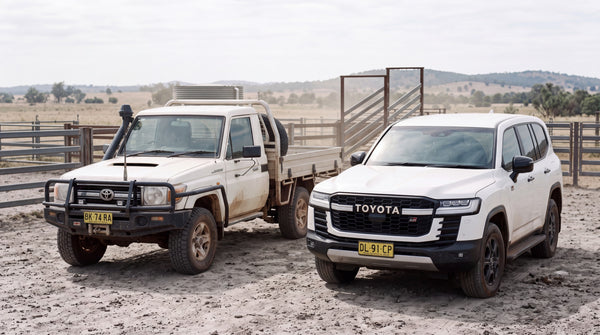
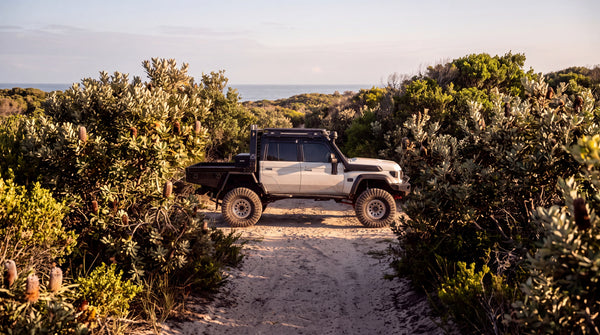
That last item is where the 70 Series conversation starts. Portal axles on a 250 Prado are a complex, expensive project. On the 70 Series, a 4-inch lift on 35s is a well-worn path with decades of documented fitment data, off-the-shelf kits and workshops across the country who've done it hundreds of times. Add a GVM upgrade, a long-range tank, a canopy or tray, dual batteries and a full interior rebuild, and you're drawing on an aftermarket that has been developing parts for this platform since the mid-1990s. That depth of support isn't something you build in a few years.
The 70 Series also gives you a solid front axle, which changes the geometry of what's possible on a rock crawl. It's not categorically better than IFS in every situation, but it's simpler to articulate, simpler to protect, and simpler to recover if something breaks in a national park. This Prado is running IFS with upper control arms, which works well, but the geometry is more sensitive to damage and the repair pathway is more involved.
The 70 isn't without its own pressures right now. The V8 is gone. The 2.8 four-cylinder with AdBlue is the only powertrain on sale, orders have been constrained, and the platform is carrying a lot of expectation for a vehicle Toyota has kept largely unchanged for decades. This Prado, with its modern ADAS suite, a factory multimedia screen and a 500Nm diesel, is a genuinely competitive alternative for someone building a rock-crawling rig from scratch.
What this build actually means
The honest read is this: the 250 Series Prado Altitude, built the way this one has been built, is a legitimate hard-trail vehicle. It's not a dressed-up touring rig with a lift kit on it. The Prado gets real credit for that, and the platform deserves to be taken seriously on tough tracks.
But the 70 Series still holds a specific advantage that matters to a certain kind of buyer: the weight of thirty years of aftermarket development, the parts that bolt straight on, the workshops that know the platform cold, and the resale market that understands exactly what a well-built 79 or 76 is worth. That's a practical asset, not sentiment, when you're two hours into Wollemi National Park and something breaks.
The argument worth having isn't whether this Prado is capable. It clearly is. The argument is whether you'd rather start with a modern platform and build the aftermarket up around it, or start with a platform the aftermarket already knows inside out. Both paths get you to the rocks. They don't get you there the same way.