


Toyota confirmed at IAA Transportation in Hannover in September 2026 that a hydrogen fuel-cell version of the ninth-generation HiLux will enter production in 2028. Toyota is targeting a range of more than 400km on the WLTP cycle and a tow rating of up to 2500kg, and it hasn't published a power output for the HiLux yet. No Australian pricing or specifications have been released, but the hydrogen HiLux is expected to follow the battery-electric HiLux, which is already on sale locally, around the time of its European launch.
For anyone running a 70 Series, this is worth paying attention to. The HiLux and the LandCruiser 70 have always competed for the same buyers at fleet level and in the grey between work rig and weekend 4x4. A zero-emissions HiLux changes that conversation in a way that the BEV version, with its real-world range limitations on a long outback run, arguably hasn't.
At a Glance
- Production confirmed for 2028, based on the ninth-generation HiLux
- Hydrogen fuel-cell powertrain, power output not yet published
- More than 400km targeted range (WLTP), up to 2500kg towing
- Expected to arrive in Australia around the same time as the European launch
- No Australian specifications or pricing announced yet
What the hydrogen HiLux actually gets right
Fast refuelling is a genuine advantage over battery-electric, and a hydrogen powertrain produces no tailpipe emissions beyond water vapour.
For urban fleets, job-site operators and buyers who want quiet running, there's a real argument here. Till Conrad, Toyota Motor Europe's Executive Vice President of Sales, put it plainly: different customers have different operational requirements, and no single technology solves every problem. That's a fair read of where the market is heading.
Toyota's European LCV range now spans battery-electric, 48V hybrid, diesel and, from 2028, hydrogen. Some of those diesel engines are already cleared to run on HVO renewable fuel. The strategy is wide, deliberately so.
Where the 70 Series holds its ground
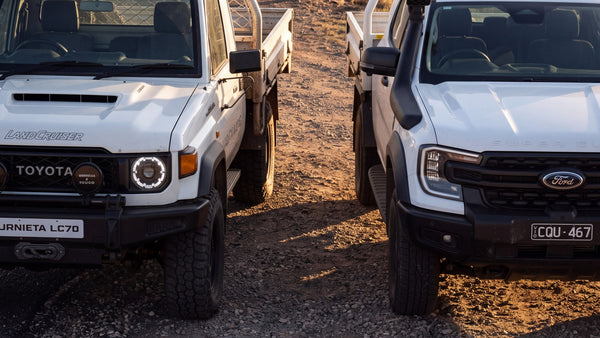
The hydrogen HiLux's tow rating of up to 2500kg is real-world useful on a job site. It is also 1000kg short of the 3500kg braked towing capacity of the 79 Series. That gap matters the moment you're moving a large caravan, a stock trailer or a boat across country.
Range is the headline number for hydrogen, and 400km on the WLTP cycle sounds strong until you apply it to a Western Australian run where the fuel stops are already sparse for diesel. Hydrogen refuelling infrastructure in Australia is genuinely limited right now. That may change by 2028, but it won't have changed everywhere by then.
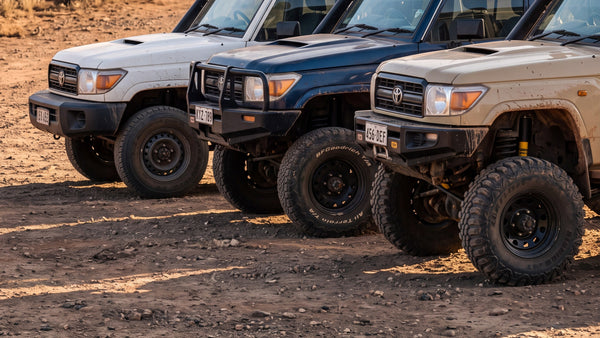
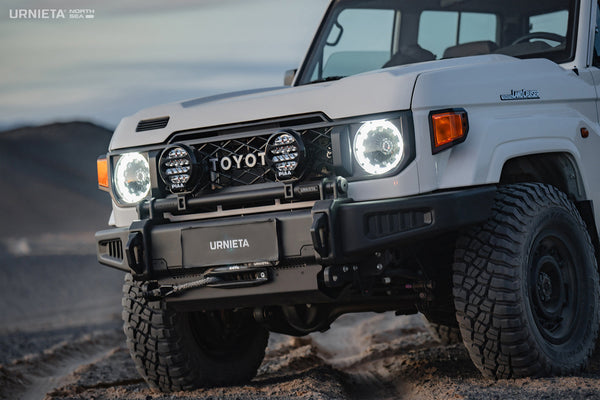
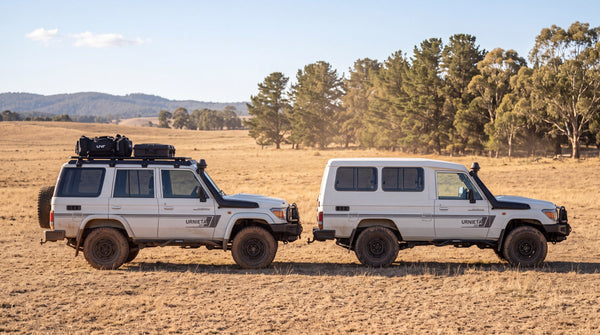
Then there's what you can do to the platform once you own it. A 70 Series with a 4-inch lift, 35-inch tyres and a GVM upgrade is a well-worn recipe. Add a rear canopy or tray, a snorkel, long-range tanks front and rear, dual battery management, and an ARB or TJM fitout and you've built something that can sit at a fuel stop anywhere in the country and be serviced by the nearest Toyota dealer if something goes wrong. The ninth-generation HiLux will develop its own aftermarket, it already has a reasonable one, but the 70 Series has been on sale continuously since 1984 and the depth of available parts, lift kits and knowledge around it is in a different category.
That's not a cheap shot at the HiLux. It's the compound effect of thirty-plus years and hundreds of thousands of vehicles on Australian roads. A brand-new powertrain, however capable, starts from zero on that count.
The V8 question keeps coming back
Toyota discontinued the 4.5-litre V8 from the 70 Series. A lot of buyers still haven't forgiven them for it. The 2.8 four-cylinder with AdBlue is a capable engine and it's improved with each revision, but the V8 crowd's argument was never really about power figures. It was about simplicity, proven reliability in remote country and the absence of a diesel exhaust fluid system to manage in the middle of nowhere.
A hydrogen HiLux reopens that debate from the other direction. The on-road refinement will almost certainly be there. Whether the infrastructure and the aftermarket support are there by 2028, or by 2030, or by 2035, is the actual question. The 70 Series, for all its age, answers that question before you even ask it.
If hydrogen infrastructure catches up
The honest position is this: if Australia's hydrogen refuelling network grows to match diesel coverage over the next decade, the case for a zero-emissions HiLux as a daily workhorse becomes very strong. Fleet buyers will move early. Regional buyers will wait for proof. And buyers who need a 70 Series-level platform because of what they do beyond the bitumen will still be looking at lift kits, GVM upgrades and long-range tank setups regardless of what the headline powertrain is.
The 70 Series isn't under existential threat from a 2028 HiLux. It is, however, being told that the field is moving. Toyota clearly knows that, which is why the multi-path strategy exists in the first place. The 70 Series diesel with AdBlue is one path. A hydrogen ute is another. Calling one of them the winner before the refuelling network exists would be the wrong argument to have.
The right argument is whether the platform you've already built, modified and trusted on rough tracks is the one you'd trade for a newer set of numbers on a spec sheet. Most 70 Series owners already know their answer.